

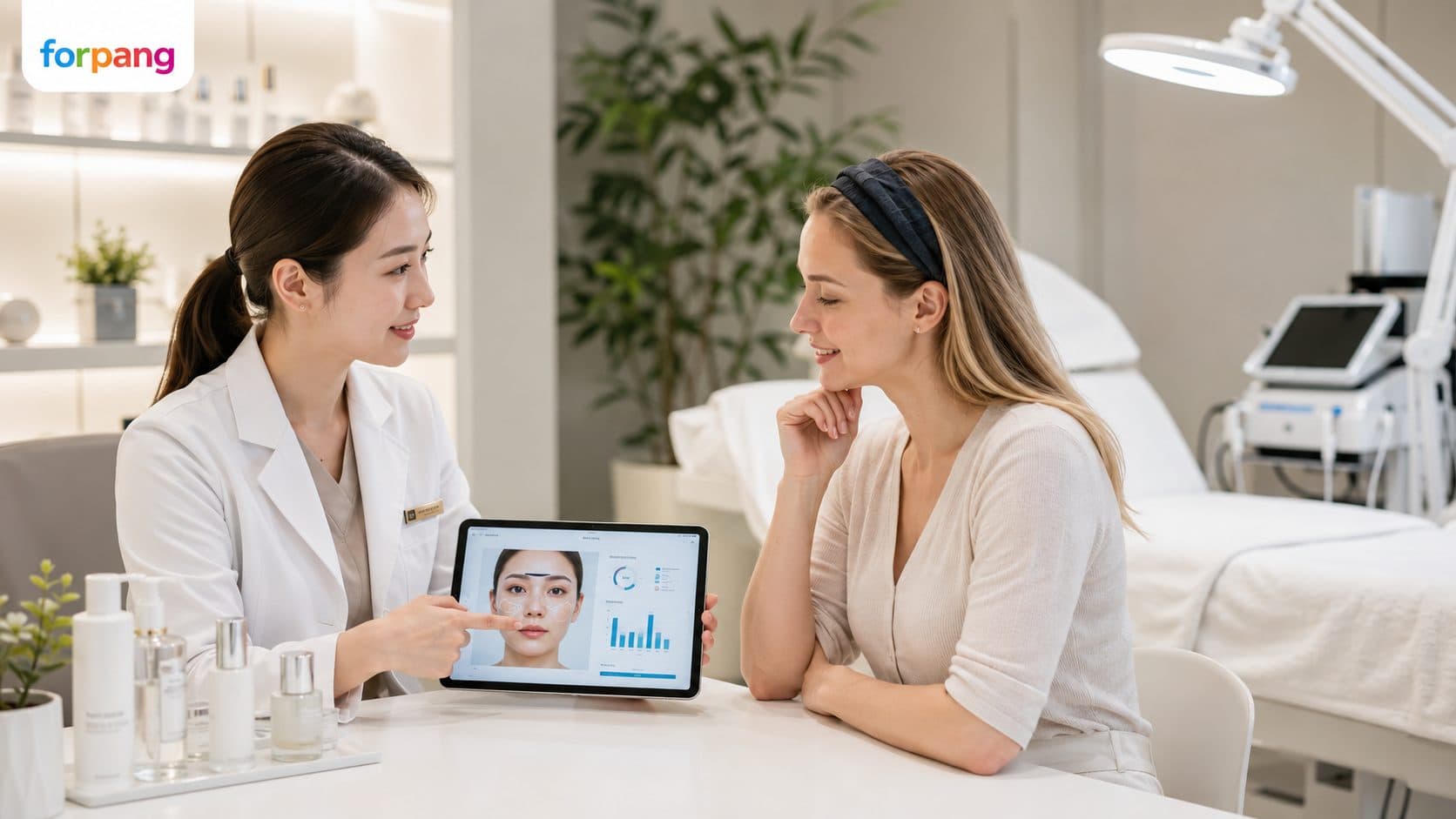
Searching for a facial treatment in Korea can become confusing very quickly. A clinic menu may place a soothing facial, chemical peel, laser, microneedling session and injectable “skin booster” beside one another - even though they work at different depths, address different concerns and can involve very different recovery plans.
The most useful starting point is not the trendiest treatment name. It is the result you want, the condition of your skin, the amount of downtime you can accept and who will be performing the procedure.
This guide explains the main categories in plain English, shows what to ask during a consultation and helps you move from a long menu to a more informed shortlist.
Need help narrowing the options? Explore Forpang’s medical and beauty services in Korea, or ask for a free consultation before choosing a clinic or treatment. Get a free consultation on WhatsApp |
Quick Answer: Which Facial Treatment in Korea Should You Choose?
Choose by concern, not by popularity. Hydration and barrier-support facials suit dryness, tightness and temporary dullness. Acne-focused care should distinguish clogged pores from persistent, painful or scarring acne.
Peels target surface texture and uneven tone at different depths. Lasers, microneedling and injectable skin-quality treatments are medical procedures that require a more detailed assessment, product or device explanation and aftercare plan.
Key Takeaways
“Facial treatment” is an umbrella term, not one standard procedure.
The same concern - such as dullness or acne marks - can have several treatment routes with different downtime and risk profiles.
A clinic should explain the exact product, peel strength, device, setting, treatment depth or injectable being proposed.
Persistent, painful, infected or scarring acne needs medical assessment rather than a routine cleansing facial alone.
For travellers, schedule the treatment around recovery time, sun exposure and access to follow-up - not only around price.
What Does “Facial Treatment in Korea” Usually Include?
There is no single procedure called a Korean facial. In practice, the phrase can describe anything from cleansing, exfoliation and a hydrating mask to a clinician-led peel, energy-based device, microneedling or an injectable treatment.
That difference matters because the treatment depth, provider, consent process, aftercare and downtime should become more specific as the procedure becomes more invasive.
A useful first step is to browse medical and beauty services in Korea to understand the available categories, then open a specific listing only after you know what kind of treatment you are comparing.
Which Facial Treatment Matches Your Skin Concern?
The table below is a decision aid, not a diagnosis. Downtime is deliberately described as a broad planning range because it changes with treatment intensity, skin response, combination procedures and aftercare.
Skin concern | Treatment category | Designed to address | Planning for downtime | Consultation question |
Dry, tight or travel-stressed skin | Hydration and barrier-support facial | Cleansing, moisturising and surface comfort | Usually none; temporary redness can occur | Which products and exfoliating steps will be used on my skin? |
Blackheads or mild congestion | Acne-focused cleansing or extraction | Surface congestion and pore care | None to a few days of redness, especially after extraction | Is this cosmetic congestion care or medical acne treatment? |
Uneven texture or superficial pigmentation | Chemical peel | Controlled exfoliation at a selected depth | From little visible downtime to several days or longer, depending on peel depth | What peel, concentration and depth are you recommending—and why? |
Redness, pigment, acne activity or texture | Laser or light-based treatment | A defined target using a specific device and settings | Temporary redness or swelling to several days or more, depending on device and intensity | What device, wavelength or energy setting is being used for my concern and skin tone? |
Dehydrated appearance or skin-quality goals | Injectable skin-quality treatment / skin booster | Product placed through injections; not a conventional facial | Injection marks, swelling or bruising can last several days | What exactly is being injected, by whom, and what are the known risks? |
Acne scars, fine texture or collagen-remodelling goals | Microneedling or collagen-support procedure | Controlled skin puncture to trigger a healing response | Redness and tenderness commonly last several days; varies by depth | What needle depth, device and infection-control process will be used? |
Unclear or mixed concerns | Skin analysis and customised plan | Assessment before selecting a procedure | None | How did the assessment change the proposed treatment plan? |
Compare the treatment - not only the package name Forpang’s current Facial Skincare Treatments listing for Lienjang Clinic includes separate acne-care, hydration, peel and rejuvenation options. Use it as a clinic-specific menu to review after you understand the categories in this guide. View the live facial skincare listing |
Hydration and Glow Treatments
Hydration-led facials are the closest match to what many people imagine when they hear “facial.” They usually focus on cleansing, gentle exfoliation, moisturising steps, masks or devices used to support a fresher-looking surface.
They are most relevant when the skin feels dry, tight, rough or temporarily dull after travel, air conditioning, weather changes or an inconsistent routine.
The realistic goal is improved comfort and a more hydrated appearance - not permanent “glass skin.” Ask whether the session includes acids, extraction, heat, suction or active ingredients, because a treatment marketed as hydrating can still contain steps that irritate reactive skin.
For an event, choose a conservative option you have time to recover from rather than stacking several unfamiliar treatments immediately before photographs or a flight.
Acne and Congestion Treatments
Acne-focused facial care can help with cleansing, comedones, excess surface oil and selected extractions, but acne is an inflammatory skin condition and not every breakout should be treated as a blocked pore.
The American Academy of Dermatology describes chemical peels, extraction and some laser or light treatments as possible parts of an acne plan; the correct combination depends on the type and severity of acne.
Use a clinician-led assessment when acne is persistent, painful, nodular, infected, suddenly worsening or leaving scars. Read the AAD overview of how dermatologists treat acne for the distinction between cosmetic care and medical treatment.
Forpang’s live Lienjang facial-skincare listing currently includes acne-care and extraction options. Treat the listing as clinic-supplied service information: confirm the branch, exact procedure, provider, final price and aftercare before booking.
Chemical Peels for Texture and Pigmentation
A chemical peel applies a chemical solution to create controlled exfoliation. The important detail is depth. A superficial peel and a stronger medical peel should not be presented as interchangeable because the expected redness, flaking, pigment risk and recovery plan can differ substantially.
The AAD recommends a consultation before a peel and specifically advises patients to ask about expected results, side effects, personal risk and before-and-after care. It also warns against unsupervised high-strength at-home peels. Review the AAD chemical-peel overview and consultation questions.
Ask the clinic to name the peeling agent, explain the intended depth and discuss recent retinoid use, active irritation, a history of pigment change and sun exposure. Sun protection and following the clinic’s healing instructions are central to reducing avoidable complications.
Laser and Device-Based Facial Treatments
“Laser facial” is too broad to be a useful booking description. Different devices use different wavelengths, pulse patterns, energy levels or delivery methods to target pigment, redness, acne activity, hair, scars or resurfacing. The same device can also be used at different settings, so a familiar machine name does not replace an individual assessment.
Laser and light treatments can cause redness and swelling, while less common complications include burns, blistering, pigment change and scarring. Provider experience and knowledge of the patient’s skin are therefore important. See the AAD laser and light guidance for acne and its laser safety guidance.
Before booking, ask what the device is intended to treat, why it suits your skin tone, whether a test spot is appropriate, what visible reaction is expected and how long you should avoid strong sun, heat, exercise or active skincare.
Skin Boosters and Injectable Skin-Quality Treatments
A skin booster is not a conventional facial. It involves injections and should be approached as a medical procedure, even when the marketing focuses on hydration or glow.
Products, ingredients, injection techniques, intended uses and evidence can differ, so the clinic should identify the exact product and explain why it is being recommended.
Ask who will inject it, what the product contains, whether the use is standard for that product, how many injections are planned, what swelling or bruising to expect and what urgent symptoms require contact.
Do not assume that an injectable is automatically better than a surface treatment simply because it is more expensive or popular.
For general injectable safety principles, the FDA advises patients to know the exact product and use an appropriately licensed, experienced healthcare provider.
Microneedling and Collagen-Support Treatments
Microneedling uses controlled punctures in the skin and is commonly discussed for acne scars, wrinkles and texture. It is more invasive than a standard facial, and the device, needle depth, hygiene process, topical products and operator training all matter.
The FDA’s microneedling guidance explains that regulated devices have specific cleared uses and that not every product marketed for microneedling is the same. Ask what device is being used, how single-use components are handled and whether active acne, infection or another skin condition changes suitability.
What Affects Facial-Treatment Prices in Korea?
A useful price comparison needs more than a headline figure. Two treatments with similar names may differ in the product, device, treatment depth, provider time and aftercare included. For that reason, this guide does not provide a generic price range.
Treatment category and clinical complexity
Exact product, peel, device or injectable used
Treatment area and number of passes, shots, cartridges or injections
Number of sessions recommended
Doctor-led treatment versus supporting skincare steps
Clinic location and provider experience
Consultation, numbing, medication, aftercare and follow-up
Combination treatments or promotional bundles
Taxes, branch-specific pricing and additional skincare products
Request an itemised quote before agreeing. Ask what is optional, what is medically necessary, whether the advertised price applies to your branch and whether a lower package price changes the product quantity, device setting or provider.
How to Evaluate a Clinic or Provider
What to verify | What good practice looks like |
Provider and clinic identity | Confirm the legal clinic name, address, who will perform each step and their relevant qualifications. |
Treatment explanation | Expect a concern-led rationale, not only a package name or influencer trend. |
Product or device transparency | Ask for the exact peel, injectable, device and settings or treatment depth where relevant. |
Consent | Risks, alternatives, expected reaction and limits should be explained before payment or treatment. |
Language support | Confirm whether interpretation covers the medical consultation, consent and aftercare—not only reception. |
Pricing clarity | Request the final total, included steps, branch conditions and likely add-ons. |
Before-and-after guidance | You should receive instructions that match the exact procedure. |
Follow-up process | Know how to contact the clinic if the skin reacts unexpectedly after you leave. |
Pressure-selling red flags | Be cautious if several procedures are added without a clear reason, adequate assessment or recovery plan. |
Questions to Ask During Your Consultation
1. What concern are you treating, and what did you see in my skin assessment?
2. What is the exact name of the treatment, product, peel or device?
3. Who will perform each part of the procedure?
4. Why is this option more suitable than a gentler or non-invasive alternative?
5. What immediate reaction and downtime should I plan for?
6. What risks are more relevant for my skin tone, medical history or current skincare?
7. Should I stop any retinoids, acids, medicines or supplements beforehand?
8. What aftercare is included, and who do I contact if I have a problem?
9. Is the quoted price final, and what optional add-ons are being recommended?
10. How will follow-up work if I am leaving Korea soon?
Safety, Suitability and Follow-Up
Cosmetic procedures can look simple, but safe treatment depends on knowledge of the skin, anatomy, devices, products and complications. The AAD’s cosmetic-safety guidance emphasises appropriately trained medical expertise for procedures that can injure the skin.
Review the AAD cosmetic-treatment safety guidance and tell the clinic about allergies, pregnancy or breastfeeding, recent procedures, active infection, cold sores, medicines, isotretinoin history, tendency to scar and previous pigment changes.
Do not schedule an unfamiliar peel, laser, microneedling or injectable immediately before a major event or international departure. Build in enough time for the expected reaction and for the clinic to review you if healing does not follow the plan.
How Forpang Can Help You Explore Facial Treatments in Korea
Forpang helps foreigners discover services and practical information in Korea. Start with the Beauty & Medical hub, then review a relevant clinic listing to compare the treatment menu, location and consultation route.
A listing can show what a clinic currently advertises, but your consultation should still confirm suitability, the exact treatment, current pricing, provider and follow-up. Forpang can help you ask the right questions and connect with an available clinic; it does not replace a medical diagnosis.
Conclusion
The best facial treatment in Korea is not the one with the strongest trend name. It is the option that matches your actual concern, is explained clearly, fits your tolerance for downtime and is delivered by an appropriate provider with a realistic aftercare plan.
Start with the simplest accurate description of what you want to improve—dryness, congestion, active acne, uneven tone, redness, texture or scarring. Then compare the treatment depth, product or device, provider and follow-up before you compare package prices.
Explore Forpang’s medical and beauty services or request a free consultation on WhatsApp to discuss which listings are most relevant to your concern and schedule.
How This Guide Was Prepared
This guide is designed to help foreign residents and visitors understand common questions before making a decision. Details should always be confirmed directly with the relevant provider or an appropriately qualified professional.
- Author
- Mustafa
- Last reviewed
- July 30, 2026
Frequently asked questions
Free clinic consultation
Share your goals and let Forpang help review available clinic options.