
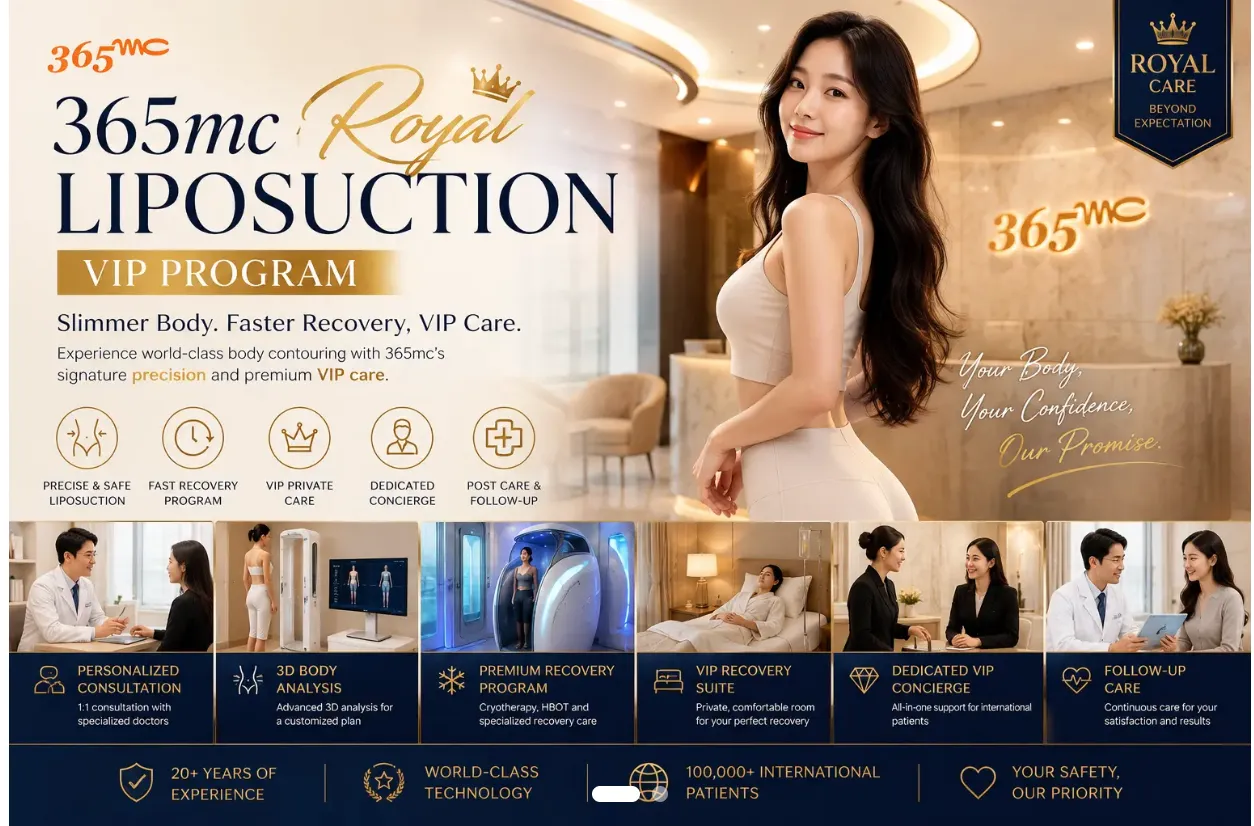
Royal Liposuction at 365mc Clinic is a surgical body-contouring programme for people considering the removal of selected areas of subcutaneous fat.
The procedure uses cannula-based liposuction to physically remove fat from beneath the skin. Depending on the treatment area, extent of surgery and patient’s medical needs, the surgical plan may involve local anaesthesia, sedation, general anaesthesia or a combination selected by the hospital’s medical team.
Royal Liposuction should not be presented as a weight-loss treatment, a treatment for obesity or a guaranteed full-body transformation. It is intended to improve the contour of clearly defined areas after an appropriate surgical assessment.
The exact 365mc hospital, surgeon, anaesthesia plan, treatment areas, expected fat-removal volume, recovery arrangements and total price must be confirmed before surgery.
Fornur helps international visitors explore Beauty & Medical services in Korea and submit consultation enquiries to available clinic partners. The consultation request is free. Surgery, hospital care, anaesthesia and additional services are charged separately.
Royal Liposuction at 365mc Clinic is a premium surgical liposuction programme for selected body-contouring concerns.
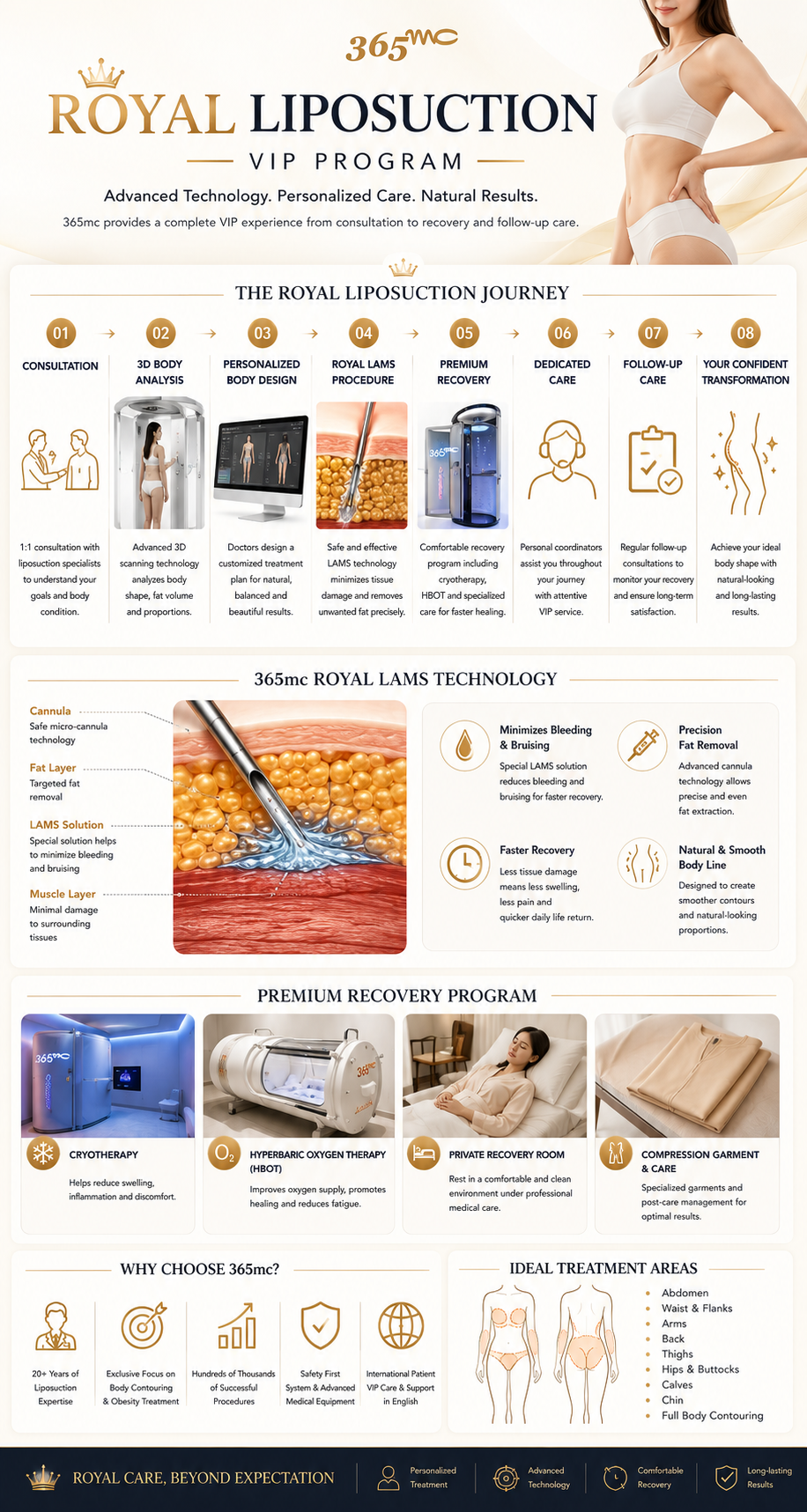
Liposuction uses a cannula and suction system to remove subcutaneous fat from defined treatment areas. The Royal programme may include personalised surgical planning, hospital-based treatment, recovery monitoring, Orange Care and international-patient coordination.
Package components are not universal. Patients should request written confirmation of the hospital, surgeon, anaesthesia, areas included, recovery services and complete price.
Royal Liposuction is different from Royal LAMS. Royal Liposuction is surgery and may be planned for broader areas or more extensive fat removal. Royal LAMS uses a more targeted, local-anaesthetic approach through smaller access points.

Treatment | General approach | Important distinction |
Royal Liposuction | Surgical cannula-based fat removal | May involve broader areas, greater treatment volumes and a more extensive anaesthesia and recovery plan |
Royal LAMS | Targeted, minimally invasive fat extraction under local anaesthesia | Intended for selected localised areas through smaller access points |
Non-surgical body contouring | External energy-based treatment | Does not physically suction fat through a cannula |
People considering a smaller or more targeted procedure can review Royal LAMS at 365mc Clinic.
People seeking an external energy-based treatment can compare non-surgical body contouring at UPIC Clinic.
The appropriate option depends on the size and number of treatment areas, fat distribution, skin elasticity, medical history, anaesthesia suitability, desired degree of change and available recovery time.
The current listing describes Royal Liposuction as a VIP programme combining consultation, surgical planning, liposuction, recovery care and international-patient assistance.
The exact inclusions can vary. They must be listed in the written quotation rather than assumed from the programme name.
Clinical components may include:
Medical consultation and health review
Body assessment and measurements
Surgical photographs and contour planning
Preoperative testing
Anaesthesia assessment
Royal Liposuction surgery
Operating-room fees
Recovery-room monitoring
Dressings and wound care
Compression garments
Prescribed medication
Follow-up appointments
Orange Care aftercare
International-patient services may include interpretation, scheduling assistance, hotel recommendations, transport coordination or remote follow-up.
Flights, accommodation, meals, airport transfers, private recovery rooms and interpretation should not be described as included unless they appear in the patient’s written quotation.
365mc promotes a technology known as M.A.I.L., which stands for Motion Capture and Artificial Intelligence-Assisted Liposuction.
The clinic describes the system as using a motion sensor attached near the liposuction cannula to record aspects of the surgeon’s hand movements as data. That information can then be analysed as part of the clinic’s technology-supported surgical process.
M.A.I.L. is a support system. It does not replace the surgeon’s judgement, qualifications, anatomical knowledge or responsibility for the operation.
It also cannot guarantee:
Perfect symmetry
Prevention of complications
A particular fat-removal volume
Faster recovery
A better result for every patient
Before the procedure, confirm whether M.A.I.L. will be used at the selected hospital, whether it applies to the planned treatment areas and whether it affects the price.
The consultation should include an assessment of the areas being considered, existing body proportions, fat distribution, skin elasticity and natural asymmetry.
Body measurements, standardised photographs and surgical markings may be used to support planning.
The current page refers to advanced 3D body analysis, but the exact scanner and system have not been confirmed. That phrase should not be retained unless 365mc verifies the device, measurements taken and hospital availability.
The surgeon should explain what can realistically be changed through liposuction and which concerns require another approach.
The current Royal Liposuction listing identifies the following potential treatment areas:
Abdomen
Waist and flanks
Love handles
Back
Upper arms
Inner and outer thighs
Hips
Calves
Chin or the area beneath the chin
Availability depends on medical suitability and the hospital’s treatment plan.
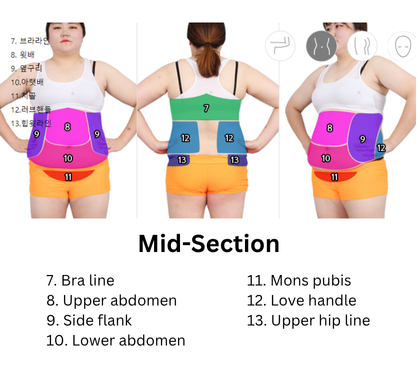
Liposuction may be considered for selected subcutaneous fat around the abdomen, waist, flanks or love handles.
It cannot remove visceral fat surrounding the internal organs. It also cannot repair separated abdominal muscles or remove substantial hanging skin.
Where loose skin or abdominal-muscle separation is the main concern, liposuction alone may not produce the desired result.
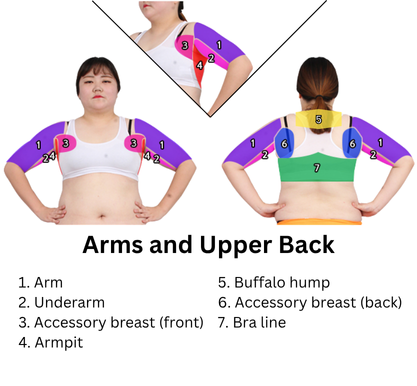
Upper-arm liposuction may be considered where arm fullness is primarily caused by subcutaneous fat.
The surgeon should assess skin elasticity, existing asymmetry, previous scars and the risk that loose skin could become more visible after fat removal.
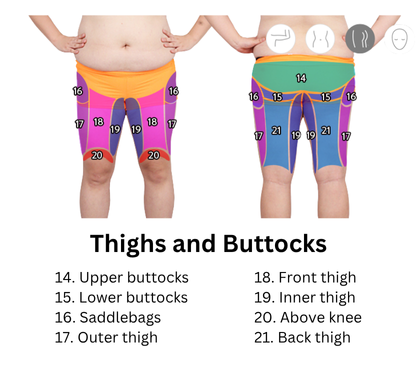
Inner-thigh, outer-thigh and hip liposuction requires careful planning across both sides of the body.
The quotation should define whether both legs are included and whether the front, back, knees or neighbouring areas form part of the treatment.
Temporary walking, exercise and compression-garment restrictions should be explained before surgery.
Terms such as back, bra line, waist, love handles and flanks can refer to different-sized areas.
The quotation should contain a precise description or marked diagram showing the treatment boundaries.
Calf size can be influenced by fat, muscle, bone structure, swelling or a combination of factors.
Liposuction can only address appropriate subcutaneous fat. It cannot reduce calf muscle or alter bone structure.
Submental liposuction requires different anatomical planning from abdominal, arm or thigh surgery.
The surgeon should assess fat distribution, skin laxity, jaw and neck anatomy, previous filler or thread treatments and the position of nearby nerves and structures.

Several areas may sometimes be treated during one operation, but the phrase “full-body transformation” should not be used.
A larger treatment plan may need to be divided into stages to manage surgical, anaesthetic, blood-clot and fluid-related risks.
The surgeon must determine:
Which areas can safely be combined
Whether surgery should be staged
The anticipated fat-removal volume
The anaesthesia required
Whether hospital admission is needed
Recovery and mobility requirements
How long the patient should remain in Korea
A greater number of areas does not automatically produce a better or safer outcome.
Royal Liposuction may be considered by adults with defined areas of localised subcutaneous fat who want contour improvement rather than substantial weight loss.
Candidates generally need realistic expectations, relatively stable weight and medical suitability for surgery and anaesthesia.
Skin elasticity is also important. Fat removal reduces volume but cannot remove significant loose skin.
The American Society of Plastic Surgeons’ liposuction guidance explains that liposuction is intended for body contouring and is not a treatment for obesity or a substitute for diet and exercise.
Royal Liposuction may not provide the desired result when the main concern is:
General obesity
Visceral abdominal fat
Significant loose or hanging skin
Abdominal muscle separation
Cellulite without a substantial fat component
Major planned future weight loss
A structural feature that fat removal cannot change
A medical condition that materially increases surgical risk
Suitability can only be confirmed by the treating medical team.


The consultation should review the requested treatment areas, height, weight, recent weight changes, skin elasticity and existing asymmetry.
The medical team should also review previous liposuction or LAMS, previous surgery, scars, hernias, allergies, medicines, supplements, smoking history and previous anaesthesia experiences.
Before booking, request written confirmation of:
Exact hospital and address
Treating surgeon
Surgeon’s qualifications and relevant experience
Anaesthesia professional
Anaesthesia plan
Surgical technique
Treatment areas and boundaries
Whether both sides are included
Estimated fat-removal volume
Whether the procedure will be staged
Expected operating and recovery time
Recovery-room or admission arrangements
Compression garment
Medication
Follow-up appointments
Emergency contact process
Complete itemised price
The hospital should provide patient-specific preparation instructions.
Tell the medical team if you have heart or lung disease, diabetes, liver or kidney disease, a bleeding condition or a personal or family history of blood clots.
Also disclose active infection, poor wound healing, a hernia near the treatment area, previous surgical complications, pregnancy, breastfeeding and any allergy or serious reaction to anaesthesia.
Smoking and vaping can affect healing and complication risk. The hospital should explain whether and when cessation is required.
Preoperative requirements may include blood tests, an electrocardiogram, medical clearance, fasting instructions, medicine adjustments and arrangements for postoperative transport or support.
Do not stop prescribed medication unless the healthcare professional responsible for it tells you to do so.
The surgeon assesses and marks the treatment areas, often while the patient is standing where appropriate.
The markings should account for fat distribution, natural asymmetry, areas where volume should be reduced and areas where fat should be preserved.
The anaesthesia plan depends on the treatment area, fat volume, procedure length, hospital and individual patient factors.
Liposuction may involve local anaesthesia, monitored sedation, general anaesthesia or a combination.
The exact anaesthesia and responsible professional must be confirmed before consent.
A tumescent or wetting solution may be introduced into the treatment area before fat removal.
The surgeon and anaesthesia team should manage the local-anaesthetic dose, fluid volume, bleeding control and overall fluid balance.
A cannula is introduced through small surgical access points, and fat is removed according to the planned contours.
The surgeon should explain the access-point locations, expected amount of fat removal, technology being used and how balance between treatment areas will be assessed.
The access points may be closed or managed according to the surgeon’s technique.
Dressings and a compression garment may be applied.
After surgery, the medical team should monitor breathing, blood pressure, heart rate, pain, bleeding, nausea, dizziness, fluid balance, skin colour and the patient’s ability to stand or walk safely.
Discharge should only occur when the medical team considers it appropriate.
There is no reliable universal procedure time for Royal Liposuction.
Duration depends on the number and size of treatment areas, estimated fat volume, anaesthesia, surgical complexity, position changes and recovery monitoring.
The complete visit may include preoperative preparation, surgery, recovery-room observation and discharge assessment.
A treatment quotation should distinguish between operating time, recovery-room time and any required admission.
Royal Liposuction is surgery and should not be described as involving minimal or no downtime.
Temporary effects can include:
Pain and soreness
Bruising and swelling
Fluid drainage
Numbness or altered sensation
Firmness
Temporary contour unevenness
Restricted movement
Fatigue
Small scars at the access points
Recovery differs considerably between a smaller single-area procedure and multi-area surgery.
The hospital should provide written instructions covering wound care, showering, medication, walking, compression garments, driving, exercise, lifting, alcohol, smoking, saunas, massage, return to work and flying.
A compression garment may be recommended to support swelling management and protect the treated area during early recovery.
The surgeon should specify:
Whether the garment is included
The correct size
When it should first be worn
How many hours per day it should be used
How long it should be continued
When it may be removed for washing
Whether another size will be needed as swelling changes
One fixed garment schedule should not be applied to every patient.
365mc publishes an aftercare programme called Orange Care.
Depending on the hospital and treatment plan, aftercare may include recovery monitoring, skin and tissue care, personalised consultations, nutritional support and additional clinic-based sessions.
The exact services and appointment schedule must be confirmed in the quotation.
Orange Care should not be presented as:
A guarantee of faster recovery
A guarantee against complications
A replacement for surgical follow-up
Automatically included in every package
Medically required for every patient
International visitors should confirm how many aftercare appointments are recommended and what happens if they leave Korea before completing them.
A change in body contour may be visible after surgery, but early swelling can hide or distort the result.
A more meaningful assessment is made gradually as swelling, bruising and tissue firmness reduce.
Results depend on the area treated, amount removed, surgical technique, existing asymmetry, skin elasticity, healing response, scar formation and future weight changes.
Royal Liposuction cannot guarantee:
Perfect symmetry
A fixed clothing-size reduction
A specific waist measurement
A permanently flat abdomen
Complete cellulite removal
No scars
No loose skin
An immediate final result
Treatment of every requested area in one operation
Identical results for every patient
Maintaining a relatively stable weight can help preserve the resulting body contour. Remaining fat cells can still enlarge if significant weight is gained.
Royal Liposuction is body-contouring surgery.
It does not treat obesity, remove visceral fat, treat metabolic disease or guarantee long-term weight control.
Patients whose primary goal is substantial weight loss should seek an appropriate medical assessment rather than relying on cosmetic fat removal.
Possible liposuction risks include:
Anaesthesia complications
Bleeding
Bruising and swelling
Infection
Fluid accumulation
Persistent numbness
Changes in skin sensation
Pigment changes
Scarring
Wound-healing problems
Contour irregularities
Asymmetry
Loose or rippled skin
Injury to nerves, blood vessels, muscles or internal structures
Need for additional treatment or revision surgery
Serious complications can include deep-vein thrombosis, pulmonary embolism, severe infection, fluid imbalance and cardiac or pulmonary complications.
Risk can increase when larger fat volumes or several body areas are treated during one operation.
The surgeon should explain the risks associated with the individual plan and how the hospital would manage a complication.
Seek urgent medical assistance for chest pain, sudden shortness of breath, difficulty breathing, coughing blood, fainting or one-sided calf pain or swelling.
Urgent assessment is also needed for heavy bleeding, rapidly increasing swelling, high fever, spreading redness, foul-smelling discharge, severe worsening pain, dark or unusually pale skin, confusion or new weakness.
The hospital should provide a direct emergency contact and clear instructions for obtaining urgent care in Korea.
International patients must receive individual travel clearance from the treating surgeon.
Surgery and prolonged immobility during air travel can both contribute to blood-clot risk.
The NHS guidance on cosmetic surgery abroad advises avoiding flying for approximately five to seven days after procedures such as liposuction. A longer period may be needed depending on the extent of surgery and individual risk.
Do not rely on a general timeframe when booking flights. Confirm the minimum stay in Korea, first follow-up appointment, compression-garment requirements, mobility instructions and blood-clot precautions with the treating surgeon.
The consultation enquiry submitted through Fornur is free. Royal Liposuction surgery is not free.
Pricing can depend on:
Exact hospital
Treating surgeon
Treatment areas
Number and size of areas
Fat volume
Surgical complexity
Anaesthesia
Operating-room fees
Preoperative testing
Recovery-room care
Hospital admission
Compression garments
Medication
Orange Care
Follow-up
Interpretation or coordination
Taxes
Before paying, request an itemised quotation confirming the exact procedure, hospital, surgeon, areas included, anaesthesia, testing, operating-room costs, recovery charges, garments, medication, follow-up and additional fees.
Flights, hotel accommodation, meals, airport transportation, interpretation and private recovery facilities should only be considered included when listed in writing.
International visitors should prepare information about the requested treatment areas, height, weight, recent weight changes, previous procedures, medical conditions, medicines, allergies, smoking history and previous anaesthesia experiences.
Include your preferred consultation and surgery dates, arrival date, departure date, available recovery time and whether someone will accompany you.
Before confirming travel, request:
Exact hospital and address
Consultation and consent language
Surgeon and anaesthesia professional
Preoperative testing requirements
Minimum stay in Korea
Recovery and follow-up schedule
Travel clearance
Emergency support
Remote follow-up arrangements
Complete treatment price
Avoid arranging Royal Liposuction immediately before an international flight or important event.
Fornur facilitates the consultation enquiry. It does not diagnose patients, choose surgical techniques, provide anaesthesia or perform surgery.
Royal LAMS at 365mc Clinic uses a targeted, local-anaesthetic fat-extraction approach and may suit different treatment areas or recovery preferences.
Body contouring at UPIC Clinic uses non-surgical energy-based technologies rather than cannula-based fat removal.
Visitors can explore the wider Beauty & Medical services hub to compare other available clinic and treatment listings.
Royal Liposuction, Royal LAMS and non-surgical body contouring differ in invasiveness, anaesthesia, treatment mechanism, recovery and expected degree of change.
Share your requested treatment areas, contour goals, height, weight, previous procedures, relevant medical history, preferred dates, arrival and departure dates and available recovery time.
Fornur can help you request current information and an itemised quotation for Royal Liposuction at 365mc Clinic.
The hospital will determine whether surgery can be offered and confirm the exact location, surgeon, anaesthesia, treatment areas, recovery plan and complete price.
Your cart is empty
Continue Shopping