
.jpg&w=3840&q=75)
.jpg&w=3840&q=75)
.jpg&w=3840&q=75)
.jpg&w=3840&q=75) 1 / 5
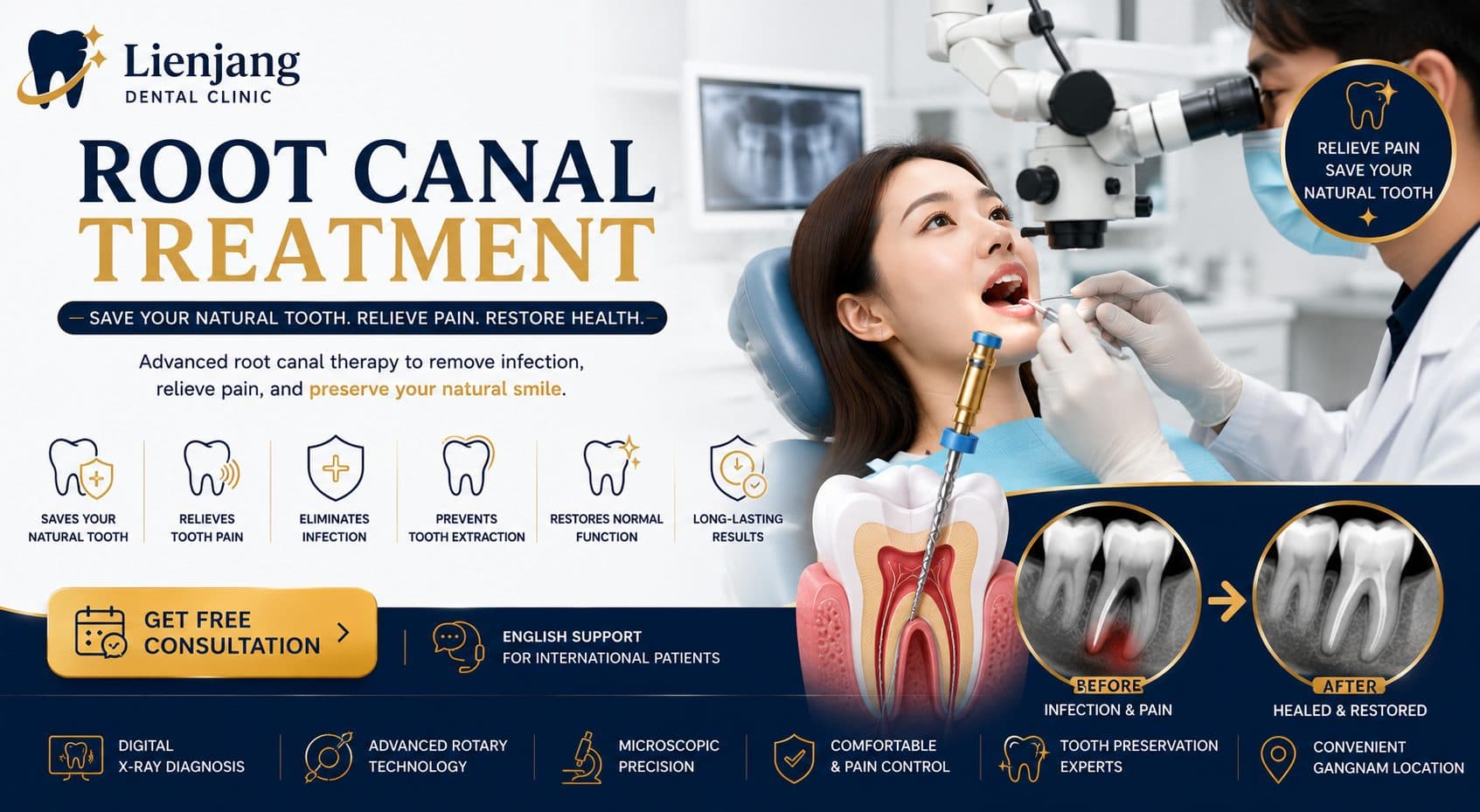
1 / 5Root canal treatment at Lienjang Dental Clinic may be recommended when the soft tissue inside a tooth has become inflamed, infected or seriously damaged.
This soft tissue is known as dental pulp. It contains nerves, blood vessels and connective tissue and extends from the centre of the tooth into narrow channels inside its roots.
During root canal treatment, the affected pulp is removed. The internal canal system is then cleaned, disinfected, filled and sealed. A filling, crown or another suitable restoration is placed to protect the remaining tooth structure.
The aim is to relieve symptoms and preserve the natural tooth where clinically possible. Treatment cannot save every damaged tooth, and a direct dental examination with appropriate imaging is required before the dentist can confirm the diagnosis.
Fornur helps international visitors explore dental treatments in Korea and request consultations with available clinic partners.
The consultation enquiry is free. Dental examinations, imaging, root canal treatment and the final restoration are charged separately.
Root canal treatment may be needed when deep decay, a crack, dental trauma or earlier dental work causes irreversible inflammation or infection inside a tooth.
The dentist removes the damaged pulp, cleans the root canals and seals the internal spaces. The tooth is then restored with a permanent filling, onlay, crown or another appropriate restoration.
Treatment usually preserves the physical roots of the tooth. Despite the name, the roots themselves are not normally removed.
Some cases can be completed during one treatment visit, while others require more than one appointment. The number of visits depends on the tooth, its root anatomy, the extent of infection and whether previous root-canal treatment is already present.
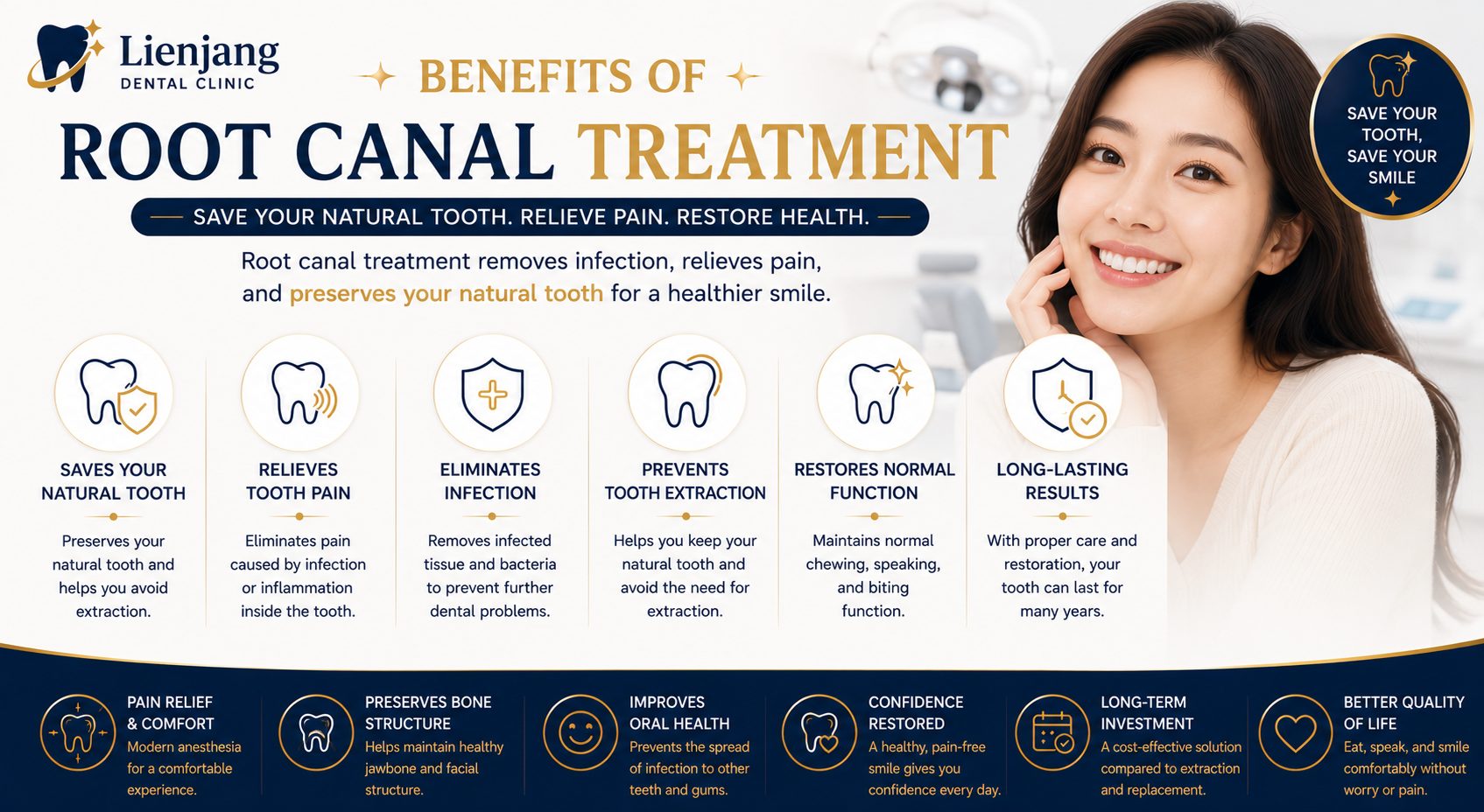
A root canal assessment may be appropriate when a tooth has deep decay, a large or leaking filling, a crack, repeated dental procedures or previous trauma.
Common warning signs include persistent toothache, prolonged sensitivity to hot or cold, pain when biting, swelling near the tooth, a small pimple-like area on the gum or darkening of the tooth.
The American Association of Endodontists’ root canal guidance identifies severe biting pain, lingering sensitivity, cracks, deep decay and swollen or tender gums as possible signs that assessment is needed.
Symptoms alone cannot confirm the diagnosis. Gum disease, teeth grinding, sinus pressure, a damaged filling and other dental conditions can create similar discomfort.
A tooth can also require treatment without causing severe pain. When the pulp is no longer vital, the initial pain may reduce even though infection or inflammation remains.
Do not wait for a routine appointment if swelling is rapidly increasing or spreading across the face or neck.
Emergency medical assessment is required when dental swelling is accompanied by difficulty breathing, speaking or swallowing. Swelling affecting the eye, severe restriction in opening the mouth or feeling seriously unwell also requires urgent care.
The NHS guidance on dental abscesses explains that breathing or swallowing difficulty, extensive mouth swelling and eye involvement require emergency assessment.
The pulp can become inflamed or infected when bacteria or trauma reach the internal part of the tooth.
This may happen because of deep decay, a cracked or chipped tooth, repeated treatment on the same tooth, a leaking crown or filling, or an injury.
The condition of the remaining tooth is just as important as the condition of the pulp. Root canal treatment may control disease inside the tooth, but the tooth must still contain enough healthy and supported structure to be restored.
Root canal treatment and extraction address the problem differently.
Option | What it involves | Main consideration |
Root canal treatment | Removes diseased tissue from inside the tooth before the tooth is sealed and restored | Preserves the natural tooth when it can be treated and restored predictably |
Tooth extraction | Removes the entire tooth from the mouth | May create a need for an implant, bridge or another tooth-replacement option |
Extraction may be recommended when the tooth has a deep root fracture, inadequate bone or gum support, extensive structural loss or another problem that prevents predictable restoration.
When a tooth cannot be saved, patients can review dental implants at Lienjang Dental Clinic.
Preserving a natural tooth is often desirable, but root canal treatment should not be recommended when the tooth cannot be restored or maintained successfully.
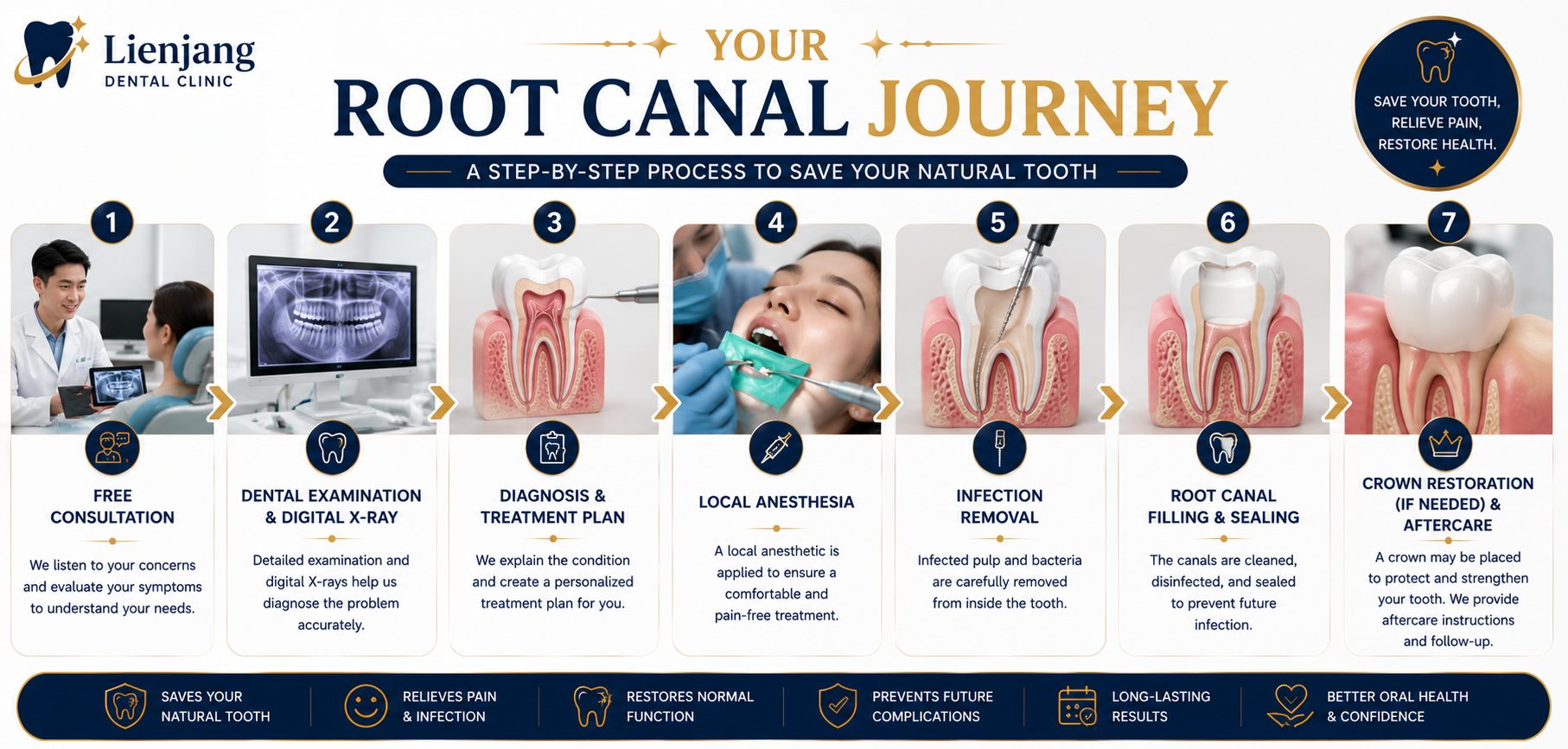
The dentist first reviews the symptoms, medical history and previous dental treatment.
The tooth may be assessed for temperature response, tenderness, mobility and pain when biting. The dentist will also examine the gums and neighbouring teeth because the source of pain is not always the tooth the patient identifies.
Dental X-rays may be needed to assess the roots, surrounding bone, depth of decay and possible infection.
More detailed imaging may be considered when the anatomy is complex, previous root-canal treatment is present or another complication is suspected.
Photographs or older X-rays submitted before the appointment can help communicate the concern, but they cannot replace a direct clinical examination.
Local anaesthetic is normally used to numb the tooth and surrounding area.
Patients may still notice pressure, vibration or movement, but sharp procedural pain should be controlled before treatment continues.
The dentist may isolate the tooth with a dental dam. This helps keep the treatment area dry and reduces contamination from saliva.
The dentist creates an opening in the tooth to reach the pulp chamber and root canals.
Inflamed, infected or non-vital pulp tissue is removed from inside the tooth.
The phrase “removing the nerve” is commonly used, but the treatment involves removing the affected pulp tissue from the full internal canal system rather than removing the tooth’s physical roots.
The root canals are cleaned, disinfected and shaped using endodontic instruments and irrigating solutions.
The objective is to remove damaged tissue and reduce contamination before the canals are sealed.
Some teeth contain narrow, curved or additional canals. Complex anatomy can affect the duration and predictability of treatment.
Some cases can proceed directly to canal filling. Other teeth may require medication inside the tooth and a temporary restoration before treatment is completed at a later appointment.
A temporary filling protects the tooth between appointments but is not intended to serve as the long-term final restoration.
Once the canals have been prepared, they are filled with a root-filling material and sealed.
The access opening is then closed with a temporary or permanent restoration.
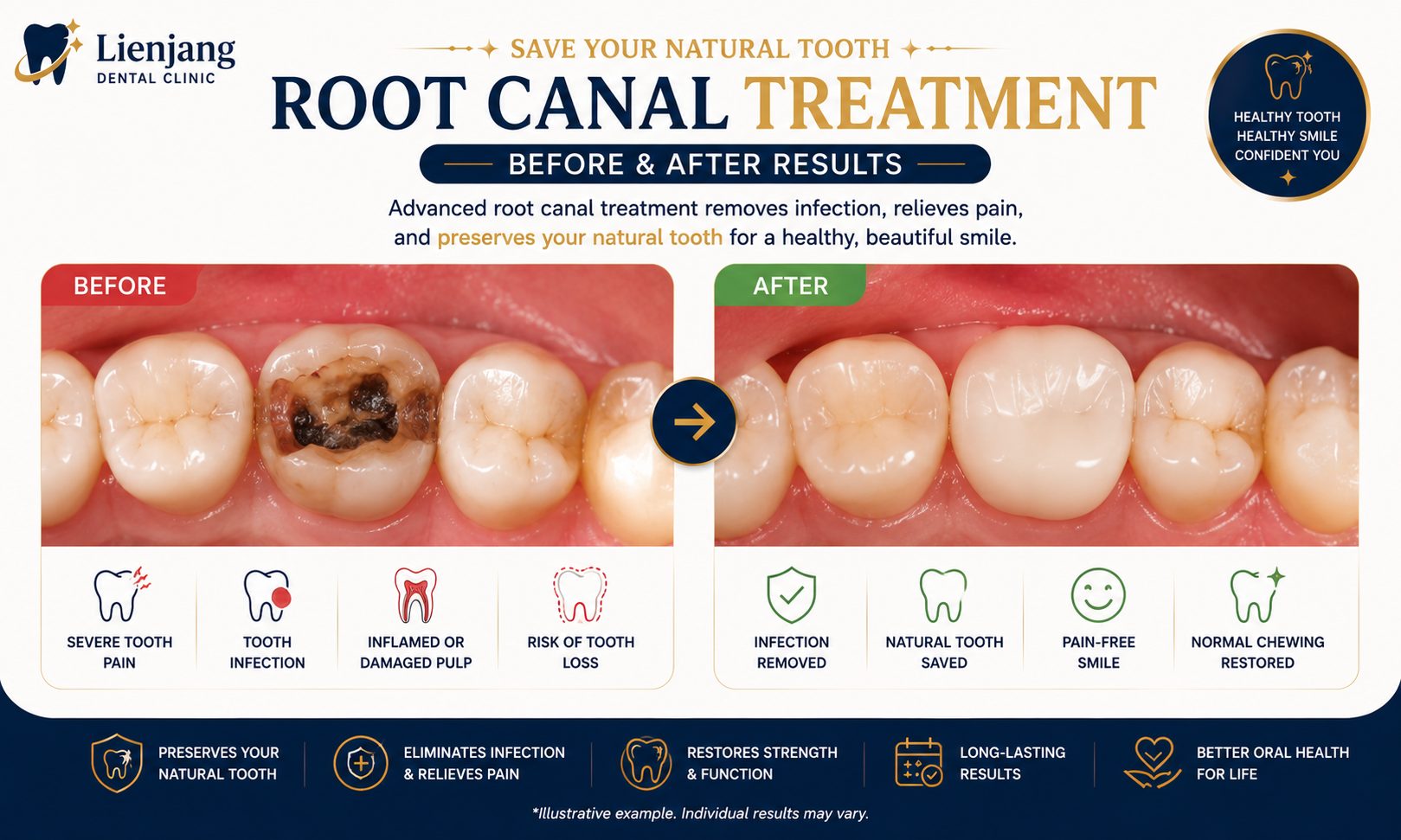
After root-canal treatment, the tooth may need a permanent filling, onlay, core build-up or crown.
The correct restoration depends on the tooth’s location, the amount of healthy structure remaining, existing cracks and the forces placed on it during chewing.
Patients advised to have greater tooth coverage can review ceramic crowns at Lienjang Dental Clinic.
No. A crown is not automatically required for every treated tooth.
Back teeth generally experience greater chewing forces and may require more protection. A front tooth with sufficient healthy structure may sometimes be restored using a filling or another more conservative option.
The dentist should consider the tooth’s position, remaining structure, size of existing fillings, presence of cracks, bite forces and teeth-grinding habits.
The American Association of Endodontists explains that molars and premolars more commonly require crowns after root-canal treatment, while some front teeth may not. The final decision must still be based on the individual tooth.
Local anaesthesia is used to control discomfort during treatment.
Patients may feel pressure, vibration or jaw fatigue from keeping the mouth open. The experience depends on the tooth, level of inflammation and individual response to anaesthesia.
The American Association of Endodontists explains that root-canal treatment is performed under anaesthesia and that mild soreness or numbness can occur afterward.
Temporary tenderness when biting is possible during the first few days. Contact the clinic if pain becomes progressively worse, returns after improving or is accompanied by swelling, fever or discharge.
There is no universal number of appointments.
A straightforward tooth may be completed during one visit. Additional appointments may be needed when the tooth has several or difficult canals, significant infection, previous root-canal treatment, an existing post or a crown that must be removed.
The final filling or crown may require a separate visit after the root-canal procedure is completed.
International patients should request a full appointment schedule before booking travel. It should include the diagnostic visit, root-canal appointments, any temporary-restoration period and the date planned for the permanent restoration.
No. Antibiotics are not routinely required for every root-canal infection.
For many localised dental infections, direct treatment of the tooth is more important than antibiotics alone.
The American Dental Association’s antibiotic guidance recommends prioritising dental procedures such as root-canal treatment or drainage for many localised pulpal and dental infections.
Antibiotics may be prescribed when infection is spreading, when fever or malaise is present or when another clinical factor makes them appropriate.
Antibiotics cannot clean, shape or seal the root-canal system. Symptoms may temporarily improve while the underlying source remains untreated.
Many patients can return to routine activities after root-canal treatment, although the mouth may remain numb for several hours.
The tooth and surrounding area may feel tender or sore after treatment. The NHS root canal recovery guidance explains that soreness and swelling should gradually improve.
Wait until numbness has worn off before eating to avoid biting the cheek, lip or tongue.
Until the tooth receives its permanent restoration, avoid hard or sticky food on that side. A tooth with a temporary filling or incomplete final restoration may be more vulnerable to damage.
Continue brushing and cleaning between the teeth, but take care around the treated area.
Contact the clinic if a temporary filling or crown becomes loose or falls out.
Long-term care includes routine dental examinations, effective oral hygiene and monitoring of the final filling or crown. Patients can review dental scaling and professional teeth cleaning at Lienjang Dental Clinic as part of ongoing care.
Root canal treatment aims to treat disease inside the tooth and preserve the natural tooth where possible.
A successfully treated and appropriately restored tooth can continue functioning for many years. However, no treatment can guarantee that the tooth will last for life.
The outcome depends on the original diagnosis, root anatomy, remaining tooth structure, quality of cleaning and sealing, final restoration, oral hygiene, gum support and future decay or trauma.
A treated tooth may later require additional care if a canal was difficult to identify, the final restoration leaks, new decay develops or the tooth fractures.
Possible future treatment can include root-canal retreatment, endodontic surgery, replacement of the restoration or extraction.
Root canal treatment is well established, but complications can occur.
These can include persistent pain, swelling, untreated or difficult canals, instrument separation, perforation, leakage beneath the restoration, reinfection, tooth discolouration or fracture.
A treated tooth can also fail if the permanent restoration is delayed, breaks or allows bacteria to enter the tooth again.
Contact the clinic promptly if you experience severe or increasing pain, visible swelling, fever, discharge, a bad taste, pain when biting, a lost temporary filling or a return of the original symptoms.
The American Association of Endodontists’ aftercare guidance also recommends contacting the treating professional when severe pressure persists, visible swelling occurs, the bite feels uneven or a temporary restoration comes out.
The consultation enquiry submitted through Fornur is free. Root canal treatment itself is not free.
The final price can vary according to the tooth, the number and complexity of its canals, whether previous root-canal treatment is present and which permanent restoration is required.
Before paying, request an itemised quotation covering:
Cost component | What should be confirmed |
Dental examination | Included or separately charged |
X-rays or additional imaging | Type, reason and price |
Root canal treatment | Tooth treated and whether the price covers all required appointments |
Local anaesthesia | Included or additional |
Temporary filling | Included and how long it is intended to remain |
Permanent filling | Included or separately charged |
Core build-up or dental post | Need and separate cost |
Ceramic crown | Material, price per tooth and laboratory cost |
Medication | Included or additional |
Follow-up | Number of included reviews |
Tax | Included or charged separately |
A quotation should also explain whether the price changes if extra canals, retreatment or a more complex restoration are identified.
The free consultation enquiry allows you to share your symptoms, previous dental treatment, available X-rays and preferred appointment dates with Lienjang Dental Clinic through Fornur.
A direct examination and current imaging may still be necessary before the dentist can confirm whether root-canal treatment is required.
The examination, dental imaging, anaesthesia, root-canal procedure, temporary filling, final restoration, crown, medication and follow-up may involve separate charges.
The free consultation should not be described as a free clinical procedure or diagnosis.
Clinic: Lienjang Dental Clinic
Location: Gangnam, Seoul
Address: 13F, 343 Gangnam Tower, 403 Gangnam-daero, Seocho-gu, Seoul
Consultation: Free consultation enquiry through Fornur
International Patients: Foreigners welcome
Language Support: English-speaking dental care is currently promoted
Monday and Friday: 10:00 AM to 9:00 PM
Tuesday to Thursday: 10:00 AM to 7:00 PM
Saturday: 10:00 AM to 4:00 PM
Lunch break: 1:00 PM to 2:00 PM
Sunday and public holidays: Closed
Opening hours, dentist availability and English-language support should be reconfirmed when the consultation is requested.
Before requesting root canal treatment at Lienjang Dental Clinic, explain which tooth or area is causing concern, how long the symptoms have been present and whether there is swelling, discharge or pain when biting.
Share details of earlier fillings, crowns, dental injuries and previous root-canal treatment.
Recent X-rays may help with preliminary communication, but the clinic may require new imaging before diagnosis.
International visitors should confirm the number of appointments, temporary-restoration arrangements and final restoration plan before booking flights.
Share the tooth or area involved, current symptoms, duration of pain, previous dental treatment, available X-rays, preferred appointment dates and available time in Korea.
Fornur can help you request a free consultation and itemised treatment plan for root canal treatment at Lienjang Dental Clinic.
The dental team will confirm whether treatment is required, whether the tooth can be restored, the number of appointments, final restoration plan, aftercare and complete price.
If the final crown or filling will be completed by another dentist after leaving Korea, request copies of the X-rays, treatment notes and details of the materials used.
Fornur facilitates the consultation enquiry. It does not diagnose dental conditions, prescribe antibiotics or perform treatment.
Visitors can also explore the wider Beauty & Medical services in Korea.
Share the tooth or area involved, current symptoms, duration of pain, previous dental treatment, available X-rays, preferred appointment dates and available time in Korea.
Fornur can help you request a free consultation and itemised treatment plan for root canal treatment at Lienjang Dental Clinic.
The dental team will confirm whether treatment is required, whether the tooth can be restored, the number of appointments, final restoration plan, aftercare and complete price.
Your cart is empty
Continue Shopping