
.jpg&w=3840&q=75)
.jpg&w=3840&q=75)
 1 / 4
1 / 4Porcelain veneers at Lienjang Dental Clinic are custom-made ceramic restorations bonded to the visible front surfaces of selected teeth.
They may be considered for persistent discolouration, small chips, uneven edges, minor gaps, irregular tooth shape or selected cosmetic alignment concerns.
Veneers change the visible appearance of teeth. They do not physically move teeth, treat active decay, cure gum disease or strengthen every badly damaged tooth.
Lienjang Dental Clinic offers its veneer programme under the LienPearl name. The clinic uses digital oral scanning, aesthetic planning and an in-house laboratory to support the design and production of selected veneers.
Some patients may qualify for a one-day workflow, but treatment time depends on the health of the teeth and gums, the number of veneers, the amount of preparation and the complexity of the planned result.
Fornur helps international visitors explore dental treatments in Korea and request consultations with available clinic partners.
The consultation enquiry is free. Dental examinations, imaging, preparation, laboratory work and porcelain veneers are charged separately.
Porcelain veneers are thin ceramic restorations that cover the front surfaces of selected teeth.
They can change visible colour, shape, size, proportion and selected minor spacing concerns. They are most appropriate when the underlying teeth and gums are healthy enough for cosmetic restoration.
Veneer treatment commonly requires the permanent removal of some enamel. It is therefore generally irreversible.
The dentist should assess your teeth, gums, bite, existing restorations and teeth-grinding history before recommending treatment.
Patients should receive a written plan confirming the number of veneers, material, proposed enamel reduction, treatment timeline, temporary restorations, final shade and complete price.
Porcelain veneers may be considered when one or more visible teeth have cosmetic concerns involving colour, shape or surface appearance.
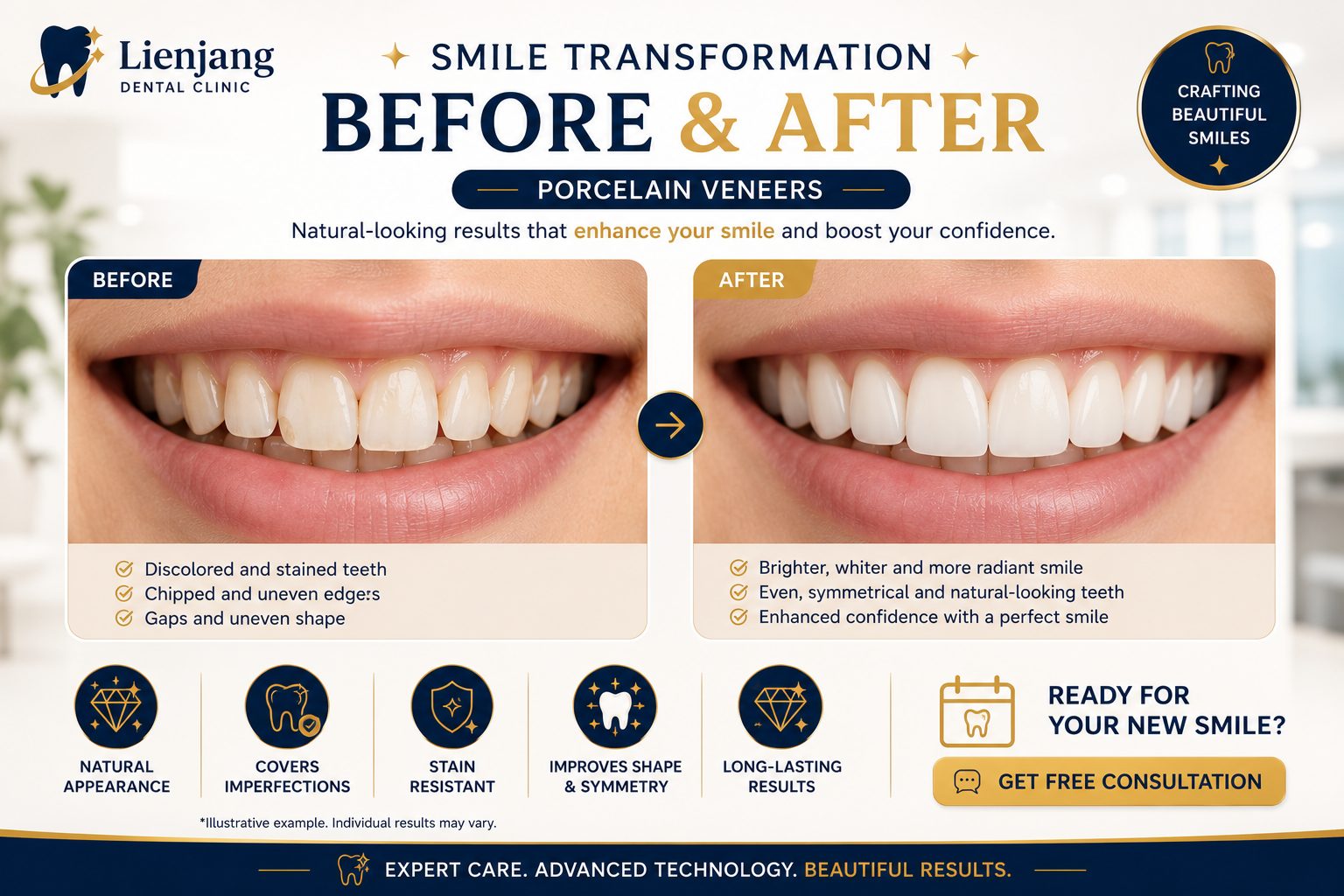
They may help improve the appearance of teeth with staining that has not responded adequately to whitening, small chips, minor gaps, worn edges or irregular proportions.
Veneers may also visually mask selected minor alignment concerns. However, they do not physically straighten teeth or correct significant crowding, rotation or bite problems.
The dentist must distinguish between a cosmetic surface concern and a structural dental problem. A tooth with extensive decay, a deep crack, a large filling or reduced strength may need a crown or another restorative treatment instead.
Patients considering several cosmetic or restorative changes can review a smile makeover at Lienjang Dental Clinic.
A direct dental examination is necessary before veneers can be recommended.
The dentist should assess the condition of the enamel, gums, bite and existing restorations. Teeth grinding, clenching, sensitivity and previous cosmetic dental treatment should also be discussed.
Dental photographs, X-rays, digital scans and bite records may be recommended depending on the case.
Lienjang Dental Clinic currently promotes digital oral scanning, visual planning and an in-house dental laboratory as part of its veneer workflow.
Digital previews can help explain the proposed tooth shape, shade and proportions. They are communication and planning tools rather than guarantees that the final veneers will look identical to a simulation.
Any active decay, infection or gum disease should normally be treated before veneer placement.
Treatment | Most relevant for | Important distinction |
Teeth whitening | Discolouration affecting suitable natural teeth | Changes tooth shade but not shape, spacing or the colour of restorations |
Porcelain veneers | Selected cosmetic concerns affecting the front surfaces of teeth | Usually requires some permanent enamel preparation |
Ceramic crowns | Teeth requiring broader structural coverage | Covers more of the prepared tooth and normally involves greater reduction |
Invisalign | Crowding, spacing, rotations and selected bite concerns | Moves teeth rather than covering their visible surfaces |
Patients whose main concern is tooth colour may first compare professional teeth whitening at Lienjang Dental Clinic.
Where a tooth is heavily restored, cracked or structurally weakened, ceramic crowns at Lienjang Dental Clinic may provide more appropriate coverage.
Patients whose main concern is tooth position can compare veneers with Invisalign clear aligners at Lienjang Dental Clinic.
The dentist should explain the least invasive suitable option before permanent tooth preparation is started.
The amount of enamel preparation depends on the original position, shape and colour of the tooth and the thickness required for the selected veneer.
Some cases may require limited reduction. Other teeth may require more preparation to provide sufficient space, correct prominence or mask darker colour.
Lienjang promotes LienPearl as an ultra-thin veneer approach involving minimal tooth reduction. This should be understood as a treatment objective rather than a promise that every patient will receive no-preparation veneers.
The American Dental Association’s guidance on veneers explains that enamel is commonly removed before a veneer is placed and that the process is generally not reversible.
Before consent, the dentist should explain how much enamel is expected to be removed from each tooth and whether a no-preparation or limited-preparation approach is clinically appropriate.
The dentist reviews your cosmetic concerns, oral health, existing dental work and desired degree of change.
The treatment plan should identify the teeth being considered, possible alternatives, expected preparation and total cost.
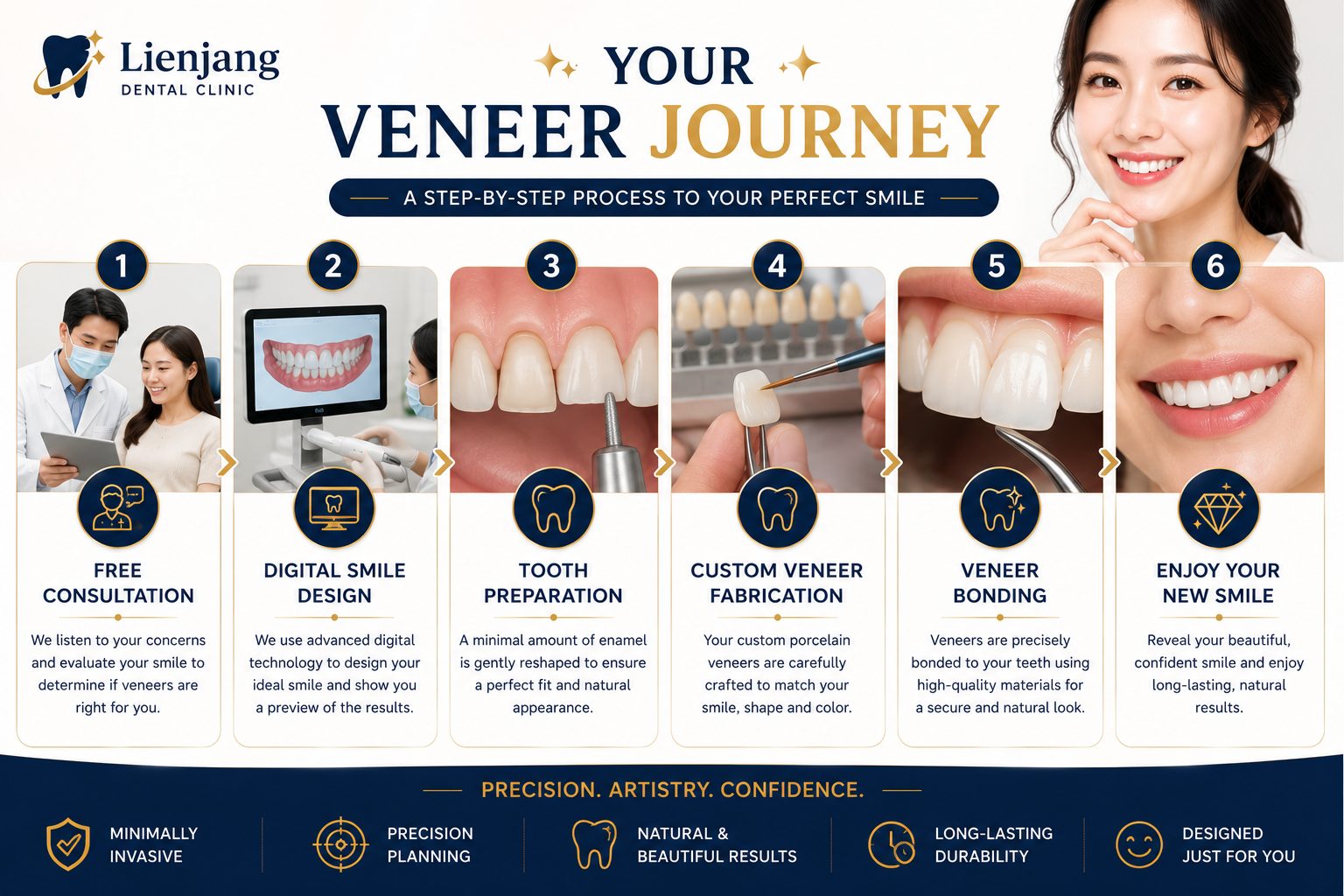
Digital scans, photographs and other dental records may be used to capture the current teeth and plan their future shape and proportions.
Shade selection should consider the neighbouring natural teeth, skin tone, lighting and whether whitening will be completed first.
Local anaesthetic may be used where required.
The dentist removes a controlled amount of enamel according to the planned veneer design. The amount should be explained before treatment begins.
The prepared teeth are then scanned or impressed so that the final restorations can be produced.
Temporary veneers may be used when the permanent restorations are not fitted during the preparation appointment.
They protect the prepared teeth and provide a temporary preview of the planned appearance.
Temporary restorations can feel different from the final veneers and may require additional care around sticky or hard foods.
Lienjang Dental Clinic produces selected dental restorations through its in-house digital laboratory.
The final veneers are designed according to the planned shape, shade, thickness and relationship with the neighbouring teeth.
Before permanent bonding, the dentist checks the shape, shade, fit, contact points and relationship with the patient’s bite.
Adjustments may be made before the veneers are bonded to the teeth.
The bite should be checked again after placement. A veneer that interferes with the normal bite may require adjustment.
Lienjang Dental Clinic currently promotes a one-day veneer workflow supported by digital diagnosis, oral scanners, milling technology and its in-house laboratory.
A faster workflow may be possible when the teeth and gums are healthy, the treatment plan is straightforward and the required veneers can be designed, produced and fitted within the available appointment time.
One-day completion is not appropriate for every patient.
More time may be required when decay or gum disease needs treatment, several veneers are planned, complex shade matching is needed, extensive enamel preparation is required or the bite needs additional assessment.
International patients should request a visit-by-visit schedule before booking flights. The clinic should confirm whether temporary veneers will be needed and when the final bite review will take place.
A veneer consultation may be appropriate for adults with healthy teeth and gums who want to improve selected cosmetic concerns affecting the front surfaces of their teeth.
Suitable patients should understand that veneers require long-term maintenance and may eventually need repair or replacement.
Veneers may be unsuitable or require additional planning where there is active decay, uncontrolled gum disease, limited enamel, severe crowding, significant tooth damage or an unstable bite.
Grinding and clenching can place additional force on veneers and increase the risk of chipping or loosening. A nightguard, orthodontic treatment or another restorative option may be recommended.
The goal should be to improve the patient’s existing smile rather than reproduce another person’s teeth or guarantee perfect symmetry.
Veneers require permanent alteration when enamel is removed.
Appropriate preparation is designed to create space for the veneer and a surface suitable for bonding. However, the tooth will normally continue to require a veneer or another restoration in the future.
The risk of unnecessary damage increases when healthy teeth are prepared more extensively than required or when active dental problems are hidden beneath cosmetic restorations.
A qualified dentist should assess whether a veneer is justified and whether whitening, orthodontics, bonding or no treatment would preserve more natural tooth structure.
Most patients can return to routine activities shortly after veneer placement.
Temporary gum tenderness, temperature sensitivity or awareness of the bite may occur. These effects should be monitored and discussed with the dentist if they persist or worsen.
Brush twice daily and clean carefully between the teeth. The natural tooth around the veneer can still develop decay, and the gums can still become inflamed.
Avoid biting ice, pens, packaging or other hard objects with veneered teeth.
Patients who grind or clench their teeth may be advised to wear a nightguard.
Professional maintenance may include dental scaling and professional teeth cleaning at Lienjang Dental Clinic.
Contact the clinic if a veneer becomes loose, chips, feels unusually high or is associated with increasing pain or sensitivity.
Porcelain veneers may improve the visible colour, shape and proportions of selected teeth.
The final appearance depends on the natural teeth, preparation, veneer material, shade, gum position, laboratory work and bite.
A natural-looking result is a treatment goal rather than a guaranteed outcome. The completed veneers may not look identical to a digital preview under every type of lighting.
Whitening products do not change the colour of porcelain veneers after they have been bonded. Patients who want to whiten their remaining natural teeth should discuss the correct treatment sequence before the final veneer shade is selected.
Veneers can chip, crack, loosen, wear or eventually require repair or replacement. Gum changes over time may also make veneer margins more visible.
There is no guaranteed lifespan for a porcelain veneer.
Many veneers remain functional for years, but longevity varies between patients.
The outcome depends on the ceramic material, preparation, bonding, bite, teeth grinding, oral hygiene, gum health, trauma and daily habits.
The existing page’s statement that veneers last 10 to 15 years or longer should not be presented as a promised result.
Routine dental reviews can help identify early signs of chipping, leakage, gum recession or bite-related stress.
Possible risks include sensitivity, gum irritation, colour mismatch, bite discomfort, loosening, chipping and fracture.
Decay can develop around or beneath a veneer if plaque collects near the margin or if the restoration loses its seal.
Some teeth may later require root-canal treatment, particularly where the tooth becomes persistently inflamed or damaged.
Patients experiencing ongoing tooth pain can review root-canal treatment at Lienjang Dental Clinic.
Contact the dentist promptly if there is increasing pain, swelling, persistent sensitivity, difficulty biting or a loose or broken restoration.
The consultation enquiry submitted through Fornur is free. Porcelain veneers are not free.
The final price may depend on the number of teeth, veneer material, amount of enamel preparation, laboratory process, temporary veneers and any treatment required before placement.
Before paying, request an itemised quotation confirming:
Cost component | What should be confirmed |
Dental examination | Included or charged separately |
X-rays and scans | Type, necessity and price |
Veneer material | Exact ceramic system proposed |
Veneer price | Price per tooth |
Tooth preparation | Expected degree of enamel reduction |
Temporary veneers | Included or charged separately |
Laboratory work | Included or additional |
Final fitting | Included adjustments and bite review |
Follow-up | Number of appointments included |
Warranty | Duration, conditions and exclusions |
Tax | Included or additional |
The quotation should also explain whether whitening, cleaning, gum treatment or another procedure is required before the veneers are produced.
The free consultation enquiry allows you to share photographs, cosmetic concerns, previous dental treatment and preferred appointment dates with Lienjang Dental Clinic through Fornur.
Photographs can support preliminary communication but cannot replace a direct dental examination.
The clinic may require X-rays, scans or another assessment before confirming suitability, preparation, number of veneers and total price.
Dental examinations, imaging, treatment planning, temporary restorations, laboratory work and permanent veneers may involve separate charges.
The free consultation should not be described as a free dental examination or free veneer treatment.
Clinic: Lienjang Dental Clinic
Location: Gangnam, Seoul
Address: 13F, 343 Gangnam Tower, 403 Gangnam-daero, Seocho-gu, Seoul
Telephone: 02-6258-2875
Consultation: Free consultation enquiry through Fornur
International Patients: Foreigners welcome
Language Support: English-speaking dental care is currently promoted
Monday and Friday: 10:00 AM to 9:00 PM
Tuesday to Thursday: 10:00 AM to 7:00 PM
Saturday: 10:00 AM to 4:00 PM
Lunch break: 1:00 PM to 2:00 PM
Sunday and public holidays: Closed
Hours, dentist availability, laboratory scheduling and language support should be reconfirmed when the consultation is requested.
Before requesting porcelain veneers at Lienjang Dental Clinic, share clear photographs of your smile if requested and details of any previous whitening, veneers, crowns, orthodontic treatment or root-canal treatment.
Mention tooth sensitivity, teeth grinding, medical conditions, medicines and allergies.
Provide your arrival date, preferred appointment dates, departure date and available time for adjustment or follow-up.
Before finalising travel, confirm the number of appointments, planned tooth preparation, temporary-veneer arrangements, production timeline and final fitting date.
Leave sufficient time after bonding for the dentist to assess the bite and complete any necessary adjustment.
Fornur facilitates the consultation enquiry. It does not diagnose dental conditions, select veneer materials or perform treatment.
Visitors can also explore the wider Beauty & Medical services in Korea.
Share your cosmetic concerns, previous dental treatment, photographs where requested, teeth-grinding history, preferred appointment dates and available time in Korea.
Fornur can help you request a free consultation and itemised treatment plan for porcelain veneers at Lienjang Dental Clinic.
The dental team will confirm whether veneers are suitable, how many teeth are involved, the proposed material, expected preparation, treatment timeline, aftercare and complete price.
Your cart is empty
Continue Shopping