
.jpg&w=3840&q=75)
.jpg&w=3840&q=75)
 1 / 4
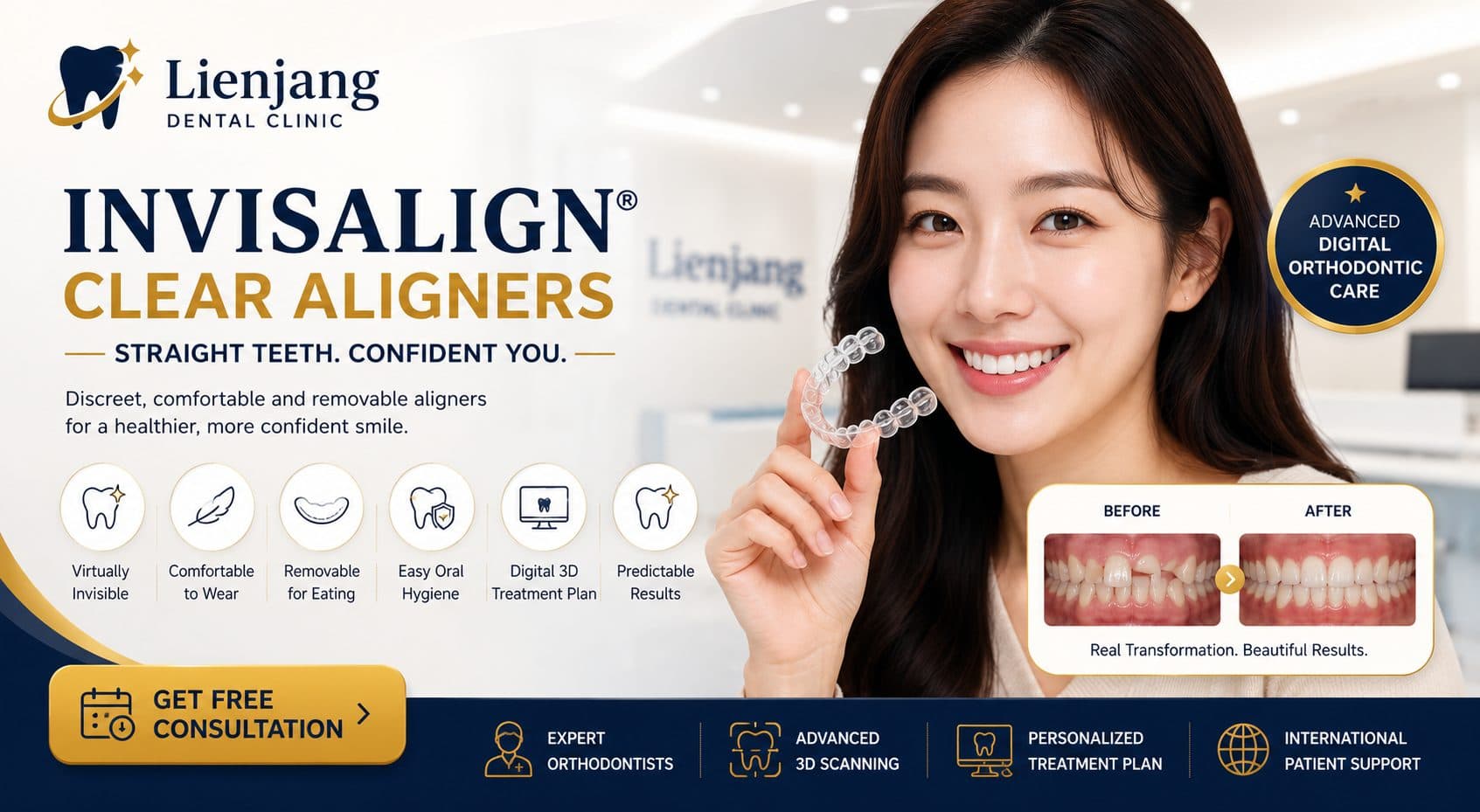
1 / 4Invisalign® at Lienjang Dental Clinic is an orthodontic treatment that uses a personalised sequence of clear, removable aligners to move the teeth gradually.
Treatment may be considered for selected concerns involving crowded teeth, gaps, rotations, crooked teeth and certain bite problems.
Unlike fixed braces, Invisalign® aligners can be removed for meals, brushing and cleaning between the teeth. However, treatment still requires consistent daily wear, professional monitoring and retainers after the active alignment phase.
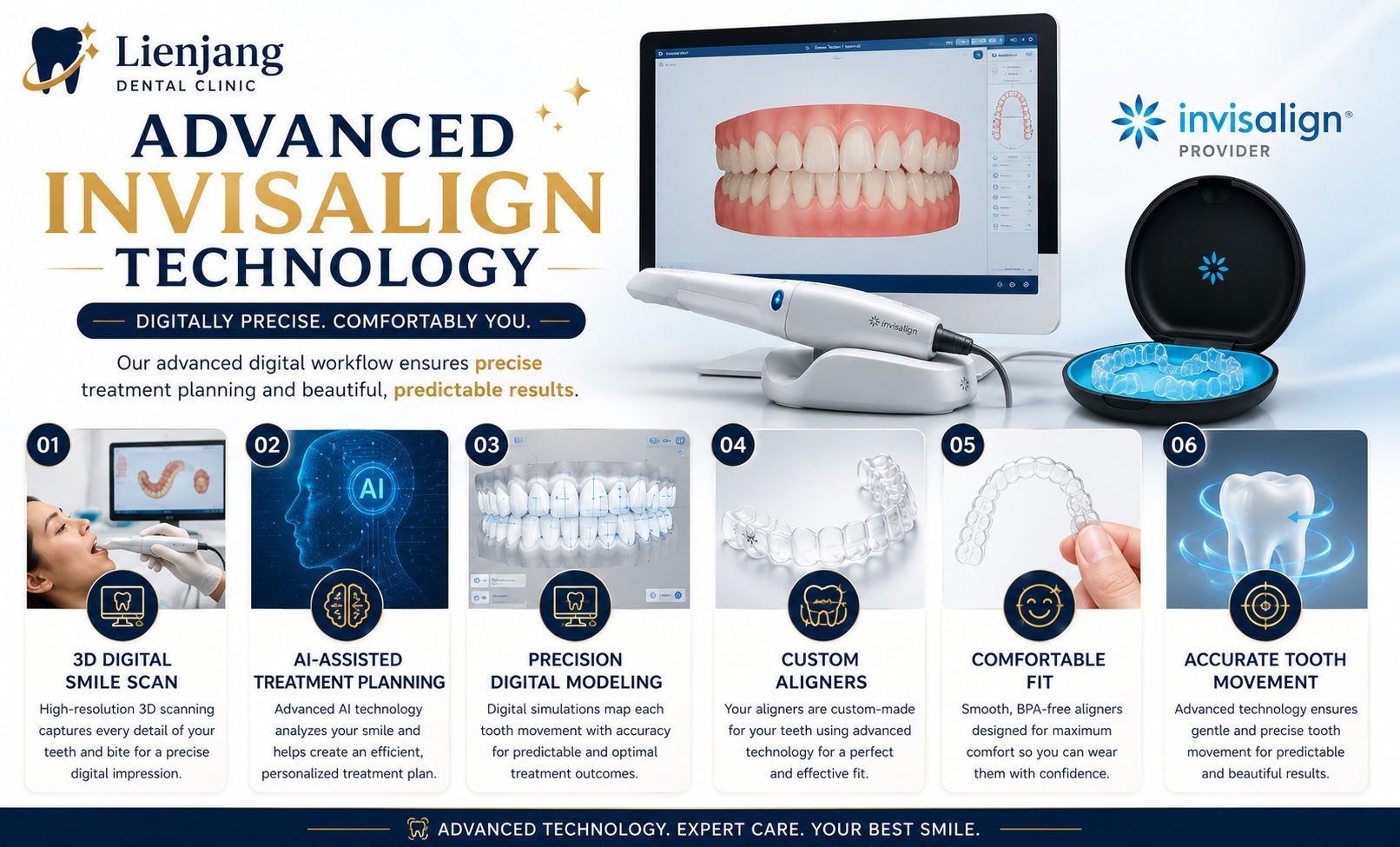
Lienjang Dental Clinic uses digital scanning and Invisalign®’s ClinCheck planning software to create and review the proposed treatment sequence. A digital simulation can help explain the planned tooth movements, but it cannot guarantee that treatment will follow the simulation exactly.
Fornur helps international visitors explore dental treatments in Korea and request consultations with available clinic partners.
The consultation enquiry is free. Dental examinations, imaging, scans, aligners, reviews, refinements and retainers may be charged separately.
Invisalign® treatment uses a series of clear plastic aligners that fit over the teeth and apply controlled pressure.
Each aligner is worn according to the prescribed schedule before the patient moves to the next aligner in the sequence.
Most patients are instructed to wear their aligners for approximately 20 to 22 hours per day. Removing them for longer than advised can delay treatment, affect the fit of later aligners and increase the likelihood of additional refinement treatment.
Invisalign® is not appropriate for every orthodontic problem. The dentist or orthodontist must assess the teeth, gums, supporting bone and bite before deciding whether clear aligners, fixed braces or another approach is more suitable.
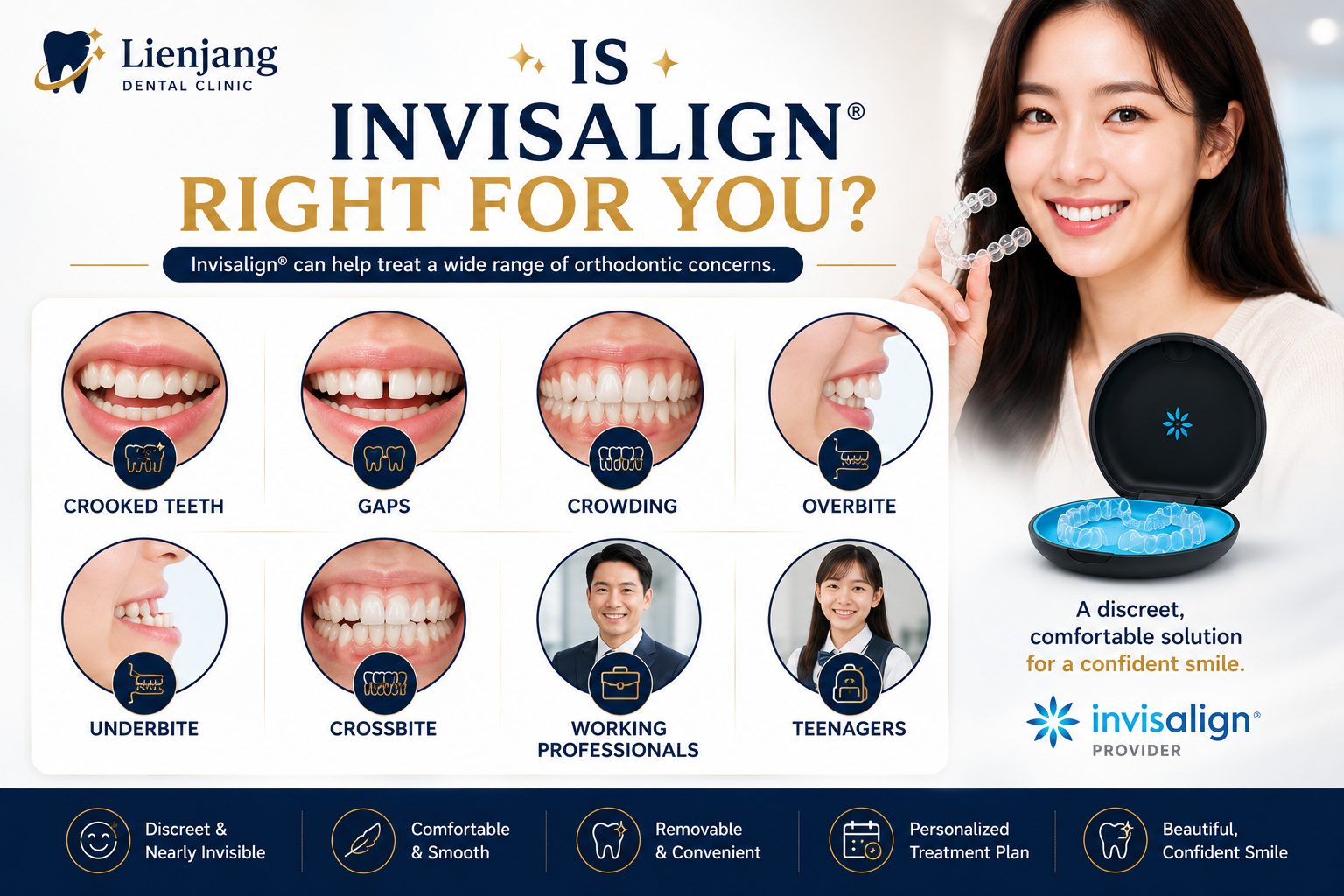
Invisalign® may be considered for selected cases involving crowding, spacing, rotations and crooked teeth.
It may also be used for certain overbite, underbite, crossbite and open-bite concerns.
The American Association of Orthodontists’ clear-aligner guidance explains that aligners can treat a range of alignment and bite problems, but they are not the correct option for every patient.
Suitability depends on the required tooth movements, jaw relationship, gum health, bone support and complexity of the bite.
Some cases may require fixed braces, orthodontic elastics, additional appliances or a combination of methods to achieve the planned result.
Treatment consideration | Invisalign® clear aligners | Traditional fixed braces |
Appearance | Clear trays are generally less noticeable | Brackets and wires remain visible unless a more discreet brace system is used |
Removability | Removed for meals and oral hygiene | Remains attached throughout treatment |
Daily responsibility | Requires consistent prescribed wear | Does not rely on remembering to insert trays |
Eating | Trays are removed before eating | Certain hard or sticky foods may need to be avoided |
Oral hygiene | Teeth can be brushed without trays in place | Additional cleaning is needed around brackets and wires |
Suitability | Appropriate for selected cases | May provide greater control in some complex cases |
Monitoring | Regular professional reviews are required | Regular adjustments and reviews are also required |
Neither option is universally better.
The appropriate choice depends on the required movements, treatment complexity, lifestyle and the patient’s ability to follow the prescribed wear schedule.
Patients considering a cosmetic alternative should understand that porcelain veneers at Lienjang Dental Clinic can change the visible shape of selected teeth but do not physically straighten teeth or correct an underlying bite problem.
Treatment should begin with an in-person assessment of the teeth, gums, bite and supporting structures.
The dental team should review previous orthodontic treatment, existing crowns or implants, teeth grinding, jaw symptoms and any history of gum disease.
Active decay, significant gum inflammation or other oral-health problems may need to be treated before aligners are produced.
Records may include digital scans, photographs, X-rays and bite measurements where clinically necessary.
The assessment should confirm whether Invisalign® is suitable and whether extractions, enamel reshaping, attachments, elastics or another supporting procedure may be required.
Lienjang Dental Clinic states that it uses digital scanning and ClinCheck Pro 6.0 software for its Invisalign® planning.
The software allows the treating professional to plan a proposed sequence of tooth movements and review a digital simulation.
The simulation should be treated as a planning and communication tool. Teeth may not move exactly as predicted, and changes to the plan may be necessary during treatment.
Before approving the plan, ask the dental team to explain the expected result, treatment limitations, number of aligners, estimated timeline and whether additional refinements are likely.
Once the treatment plan has been approved, a numbered series of aligners is produced.
The dental team should explain how to insert, remove, clean and store the trays.
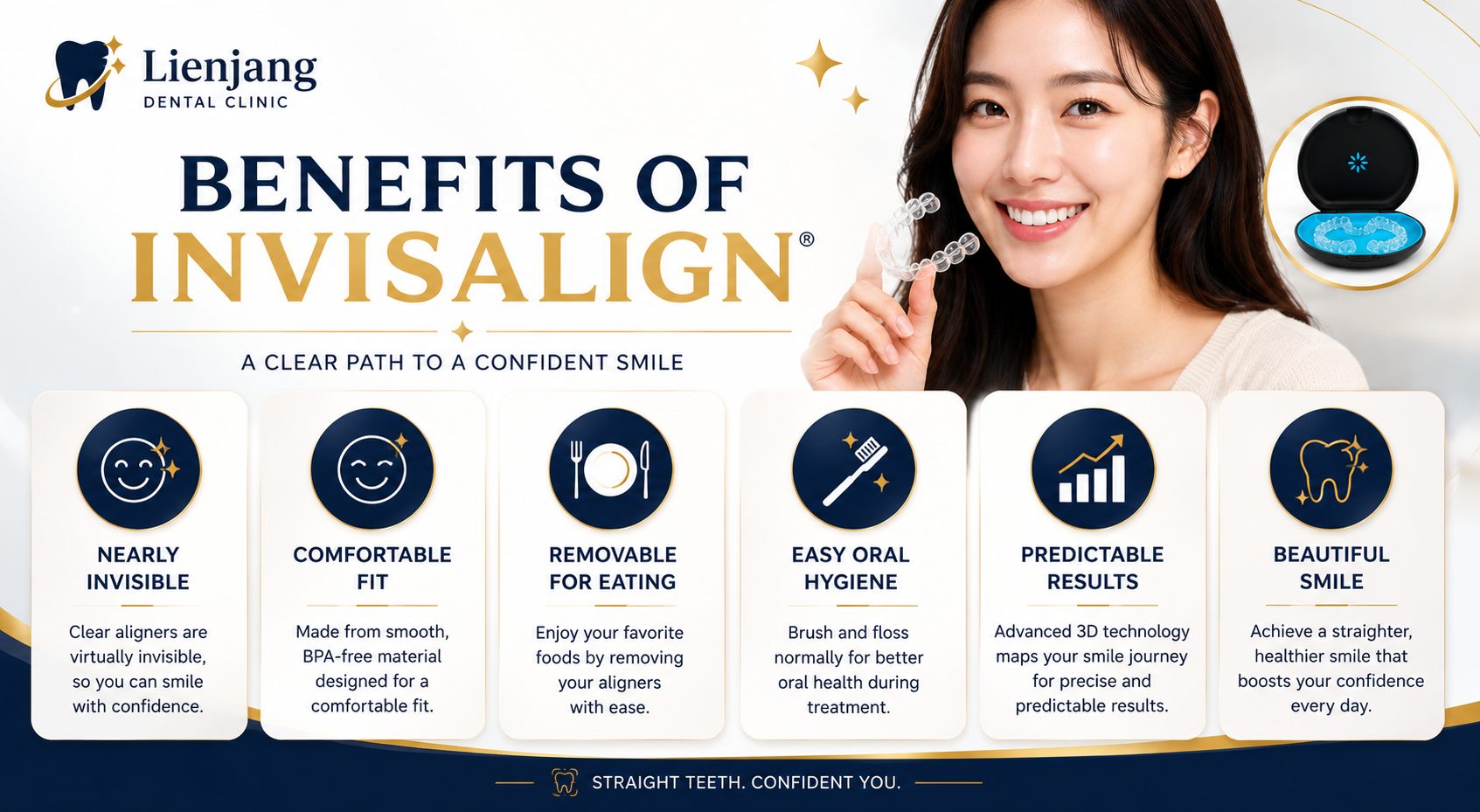
Small tooth-coloured attachments may be placed on selected teeth. These help the aligners apply force in the required direction and can be visible at close range.
Some patients may also need interproximal reduction. This involves removing a controlled amount of enamel between selected teeth to create space for movement.
Attachments, enamel reduction and other supporting steps should be explained before treatment begins.
The aligners must be worn according to the schedule provided by the treating professional.
Most Invisalign® guidance recommends approximately 20 to 22 hours of wear each day.
The trays should normally be removed for meals, snacks and drinks other than plain water. They should also be removed for brushing and cleaning between the teeth.
Each aligner is changed according to the prescribed schedule. Do not move to the next aligner early unless the dental team instructs you to do so.
If an aligner does not fit properly, becomes damaged or is lost, contact the clinic before changing the sequence.
Aligners should normally be removed before eating.
Wearing trays while consuming sugary, acidic or coloured drinks can trap liquid against the teeth, stain the aligners and increase the risk of enamel or gum problems.
Brush your teeth before reinserting the aligners whenever practical. Food particles left beneath the trays can contribute to decay, gum inflammation, bad breath or white enamel marks.
Clean the aligners using the method recommended by the clinic. Hot water can distort aligner material and affect the fit.
Patients can support their oral health during treatment with dental scaling at Lienjang Dental Clinic.
Regular reviews allow the dental team to check tooth movement, aligner fit, attachment condition, gum health and progress against the treatment plan.
Lienjang currently publishes a typical review interval of approximately six to eight weeks.
That interval should not be treated as fixed for every patient. Some cases may require earlier or more frequent assessment.
Patients travelling outside Korea must confirm how many in-person appointments are required and whether remote monitoring is available.
They should also ask what happens if an attachment breaks, an aligner stops fitting or treatment progress differs from the original simulation.
There is no universal Invisalign® treatment time.
A limited alignment concern may require a shorter treatment course, while complex crowding or bite correction can take considerably longer.
Treatment duration can be affected by the number of planned movements, daily wear, missed appointments, aligner fit and individual biological response.
Some patients require refinement aligners after the first sequence. Refinements provide additional movements when the initial aligners have not produced the complete planned result.
The written treatment plan should show the estimated duration, number of aligners, review schedule and whether refinements are included in the price.
An estimated completion date is not a guarantee.
Invisalign® treatment does not involve surgical recovery, but it can cause temporary discomfort.
Starting treatment or changing to a new aligner can create pressure, tightness or soreness as the teeth begin moving.
Some patients notice temporary speech changes, increased saliva, dry mouth or irritation around the gums, tongue or cheeks.
These effects often improve as the mouth adapts.
Contact the clinic if an aligner has a sharp edge, causes persistent pain, does not fully fit over the teeth or is associated with significant swelling or injury.
Retainers are an essential part of orthodontic treatment.
Teeth can continue to move after active Invisalign® treatment has finished. Retainers help maintain the corrected positions while the surrounding tissues adapt.
The retainer may be removable, fixed or a combination selected according to the treatment plan.
The required wear schedule should be explained before active treatment ends.
The quotation should state whether the first retainers, replacement retainers and post-treatment reviews are included.
The American Association of Orthodontists’ retainer guidance explains that teeth can shift after orthodontic treatment and that retainers are used to maintain their corrected positions.
Invisalign® may not be the most suitable option when the required movements are too complex for predictable aligner control.
Additional planning may also be needed where there is active gum disease, inadequate bone support, extensive untreated decay or teeth that cannot tolerate orthodontic movement safely.
Treatment may be unsuitable for patients who are unable or unwilling to wear aligners consistently.
Fixed braces or a combined approach may provide better control in some cases.
The decision should be based on a complete clinical assessment rather than photographs or a digital simulation alone.
Clear-aligner treatment is widely used but is not risk-free.
Temporary pressure, soreness, gum irritation and speech changes can occur.
Possible dental or orthodontic complications include decay, gum inflammation, enamel changes, gum recession, unwanted bite changes, root shortening, loss of tooth vitality and relapse after treatment.
The risk of gum or tooth complications can increase when active disease is present or when oral hygiene and follow-up are inadequate.
Attachments may be visible, and some patients need enamel reduction, elastics, additional aligners or a change to fixed braces.
Treatment cannot guarantee perfect alignment, permanent stability or an exact completion date.
The final result may differ from the ClinCheck simulation.
The consultation enquiry submitted through Fornur is free. Invisalign® treatment is not free.
The complete cost may depend on treatment complexity, treatment length, number of aligners and whether additional procedures are required.
Before paying, request an itemised quotation confirming:
Cost component | What should be confirmed |
Orthodontic examination | Included or charged separately |
Digital scans and imaging | Included records and additional charges |
Invisalign® package | Exact package or treatment level |
Aligners | Number included in the initial plan |
Attachments | Placement and removal costs |
Interproximal reduction | Whether it is included |
Review appointments | Number and frequency included |
Refinement aligners | Number of refinement rounds covered |
Replacement aligners | Cost if a tray is lost or damaged |
Retainers | First set and replacement fees |
Extended treatment | Charges if treatment exceeds the original plan |
Tax | Included or additional |
Do not assume that scans, attachments, refinements, retainers or every review appointment are automatically included.
The free consultation enquiry allows you to share your alignment concerns, previous orthodontic history, photographs and preferred appointment dates with Lienjang Dental Clinic through Fornur.
Photographs can support initial communication but cannot establish Invisalign® suitability.
A direct examination, digital scan and relevant imaging may still be required before the clinic can confirm the treatment plan, timeline and complete price.
The examination, scans, X-rays, aligners, attachments, refinements, retainers and follow-up may involve separate charges.
The free consultation should not be described as a free Invisalign® scan or free orthodontic treatment unless confirmed in writing.
Clinic: Lienjang Dental Clinic
Location: Gangnam, Seoul
Address: 13F, 343 Gangnam Tower, 403 Gangnam-daero, Seocho-gu, Seoul
Telephone: 02-6258-2875
Consultation: Free consultation enquiry through Fornur
International Patients: Foreigners welcome
Language Support: English-speaking dental care is currently promoted
Monday and Friday: 10:00 AM to 9:00 PM
Tuesday to Thursday: 10:00 AM to 7:00 PM
Saturday: 10:00 AM to 4:00 PM
Lunch break: 1:00 PM to 2:00 PM
Sunday and public holidays: Closed
Opening hours, orthodontic staff availability, review scheduling and English-language support should be reconfirmed when the consultation is requested.
Invisalign® treatment normally continues for months rather than being completed during a short visit to Korea.
Before starting treatment, confirm who will supervise the case after you leave Korea and how progress will be reviewed.
Ask how additional aligners will be delivered, how attachments will be repaired and what support is available if a tray no longer fits.
Patients who have a dentist or orthodontist in their home country should ask whether treatment records can be shared and whether local monitoring will be required.
Do not assume that another provider will automatically take over a treatment plan created in Korea.
Fornur facilitates the consultation enquiry. It does not diagnose orthodontic conditions, manufacture aligners or supervise tooth movement.
Visitors can also explore the wider Beauty & Medical services in Korea.
Share your alignment concerns, previous orthodontic treatment, current dental work, preferred appointment dates and plans for follow-up after leaving Korea.
Fornur can help you request a free consultation and itemised treatment plan for Invisalign® at Lienjang Dental Clinic.
The dental team will confirm whether Invisalign® is suitable, the planned tooth movements, estimated duration, review schedule, aligner package, retention plan and complete price.
Your cart is empty
Continue Shopping