
.jpg&w=3840&q=75)
.jpg&w=3840&q=75)
.jpg&w=3840&q=75)
.jpg&w=3840&q=75)
 1 / 5
1 / 5Ceramic crowns at Lienjang Dental Clinic are custom-made restorations designed to cover and protect a prepared natural tooth.
A crown may be recommended when a tooth is significantly weakened, cracked, heavily filled, worn or affected by extensive decay. It may also be used to restore selected teeth after root-canal treatment or to create the visible tooth-shaped restoration attached to a dental implant.
Crown treatment normally requires permanent removal of some natural tooth structure. The dentist should therefore determine whether a crown is necessary or whether a filling, inlay, onlay or veneer could preserve more of the tooth.
Lienjang Dental Clinic uses digital dental scanning, imaging and an in-house laboratory to support the planning and production of selected restorations. Some cases may qualify for a faster prosthetic workflow, but the timeline depends on the condition of the tooth, the crown material and whether additional dental treatment is required.
Fornur helps international visitors explore dental treatments in Korea and request consultations with available clinic partners. The consultation enquiry is free. Dental examinations, imaging, laboratory work and crown treatment are charged separately.
Ceramic crowns at Lienjang Dental Clinic may be used when a tooth requires more structural coverage than a filling, inlay, onlay or veneer can provide.
Treatment generally involves examining the tooth, reviewing appropriate imaging, selecting the crown material, preparing the tooth and recording a digital scan or impression. The completed crown is then checked for fit, shade, contact with neighbouring teeth and bite before final placement.
A temporary crown may be required while the permanent restoration is being produced.
Ceramic is a broad category of dental material rather than one single product. The exact ceramic system, laboratory process, number of visits and price must be confirmed after examination.
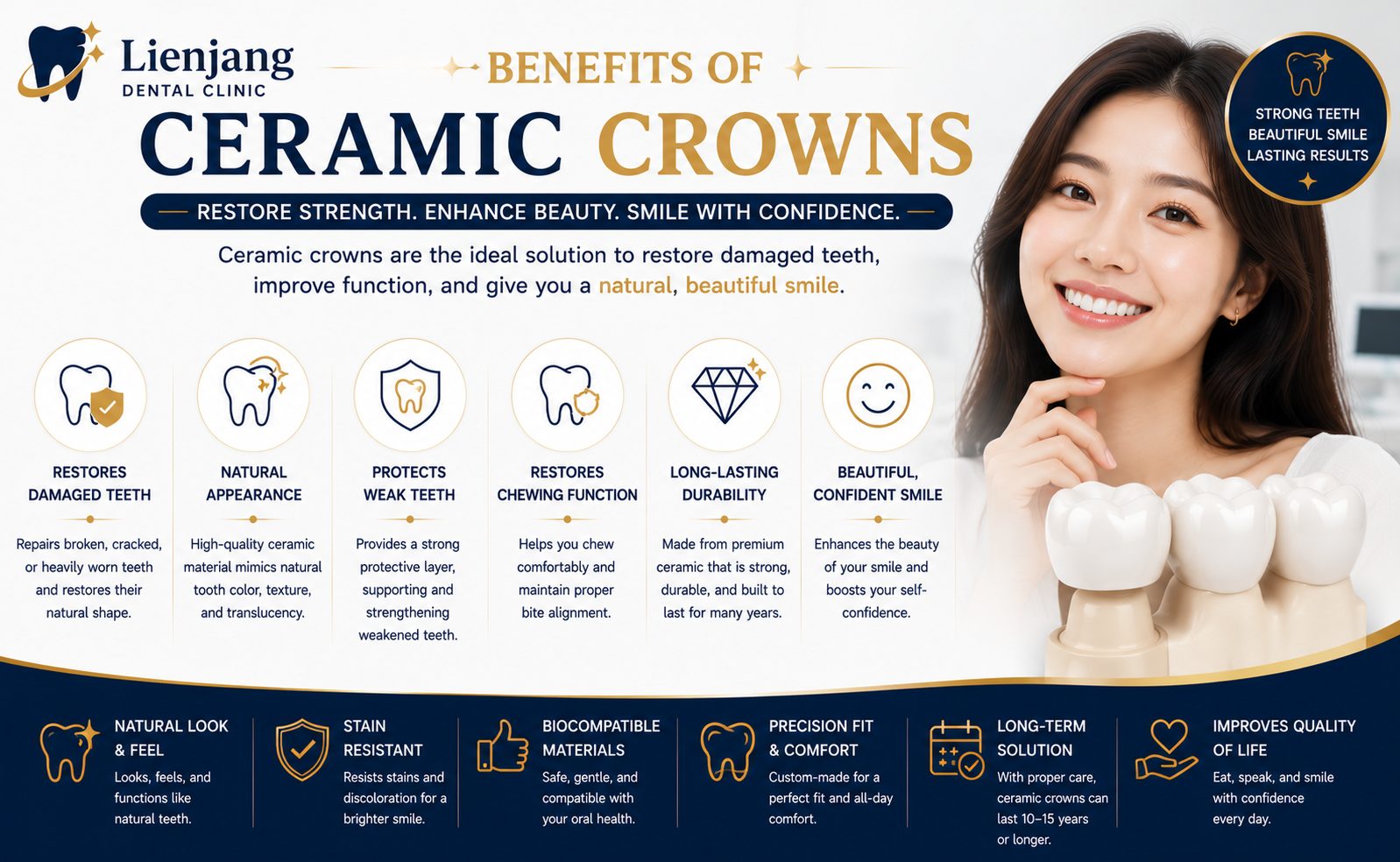
A ceramic crown is a tooth-shaped restoration that covers most or all of the visible part of a prepared tooth.
Its purpose may include protecting weakened tooth structure, restoring shape, rebuilding a worn or broken tooth and creating an appropriate biting surface.
A crown can also improve the appearance of a selected damaged or heavily restored tooth. However, it should not automatically be recommended for an otherwise healthy tooth solely to change its colour.
The American Dental Association’s patient guidance on crowns explains that crowns can be used to repair teeth that are damaged, weakened or extensively restored.
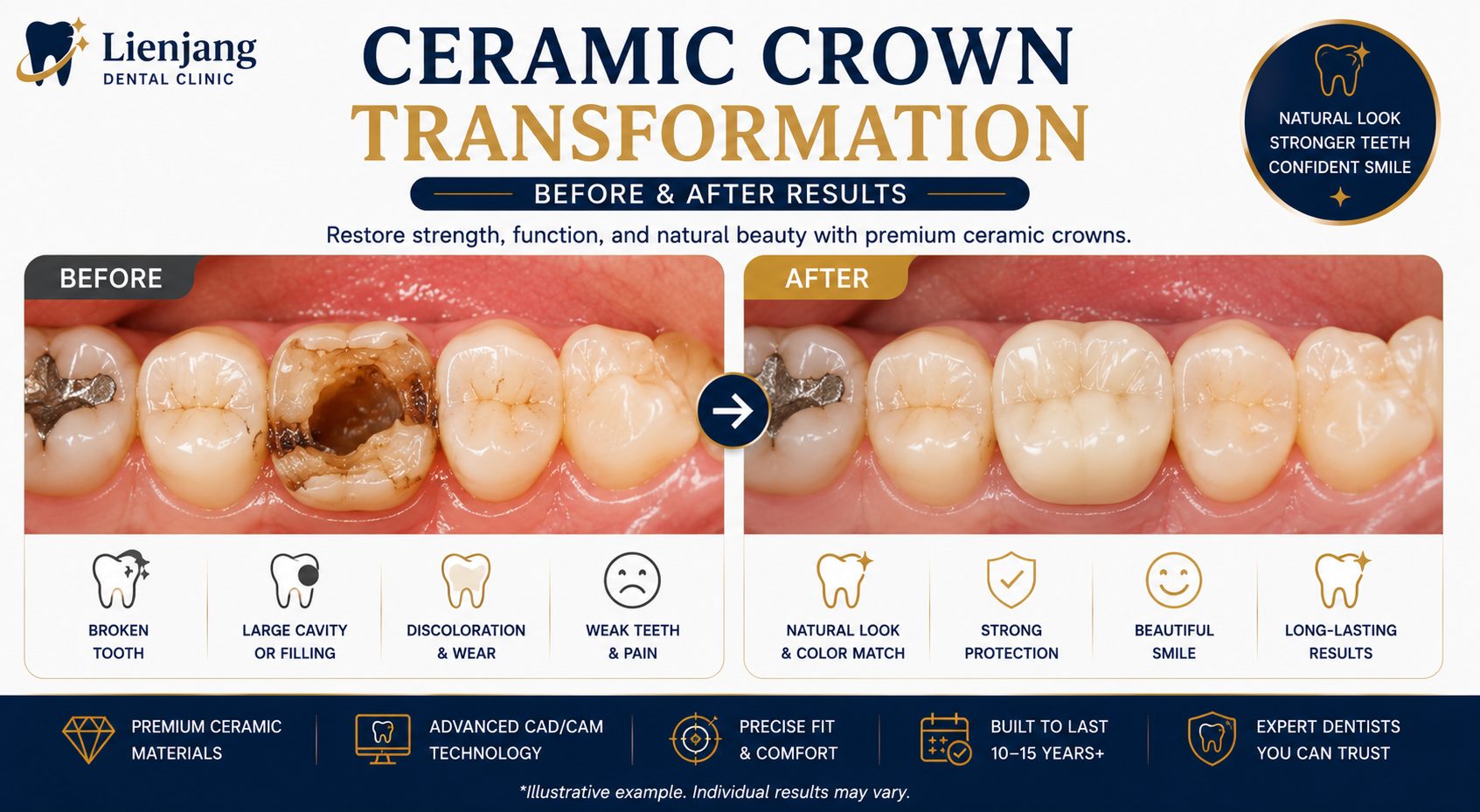
A crown may be considered when decay or an existing filling has removed too much healthy structure for another filling to provide reliable support.
The dentist should assess how much natural tooth remains, whether the dental pulp has been affected and whether the tooth can support a long-term restoration.
A core build-up or root-canal treatment may be required before crown placement. Early or more limited damage may still be suitable for a smaller restoration.
A crown may help protect a tooth that has lost substantial structure or contains a crack that the dentist considers restorable.
The suitability of a crown depends on the position and depth of the crack. A crown cannot save every fractured tooth.
Cracks extending deeply into the root or below the gum line may require a different treatment, including extraction.
A crown may be considered when a tooth has lost substantial shape, height or strength through wear.
Before restoring it, the dentist should investigate why the wear occurred. Teeth grinding, clenching, bite problems, acid erosion and reflux can continue placing stress on both natural teeth and new restorations.
A nightguard or another preventive measure may be recommended where grinding is present.
Some root-canal-treated teeth require additional coverage because decay, earlier fillings and the treatment access opening have reduced the amount of strong tooth structure remaining.
A crown is not automatically required after every root canal. The recommendation depends on the tooth’s position, remaining structure, existing cracks and normal chewing forces.
Patients who may require endodontic treatment can review root-canal treatment at Lienjang Dental Clinic.
Root-canal treatment, a core build-up, a dental post and the final crown should be quoted separately unless the clinic confirms that they form part of one package.
A ceramic crown can form the visible restoration placed over a dental implant.
An implant-supported crown does not sit over a prepared natural tooth. It attaches to an implant fixture through an abutment or another prosthetic connection.
The full implant cost may involve the implant fixture, abutment, temporary restoration, final crown and additional laboratory components.
Patients replacing a missing tooth can review dental implants at Lienjang Dental Clinic.
A crown may sometimes be considered for a tooth with significant discolouration, abnormal shape, extensive wear or an existing large restoration.
However, crowning a healthy tooth generally requires more tooth reduction than treatments that cover only part of the tooth.
Depending on the concern, the dentist may discuss whitening, a veneer, orthodontic treatment, composite restoration or no treatment.
Patients whose main concern is tooth colour can compare professional teeth whitening at Lienjang Dental Clinic.
Patients considering a thinner front-surface restoration can review porcelain veneers at Lienjang Dental Clinic.
Ceramic is a material category rather than one universal crown product.
Different ceramic materials can provide different combinations of strength, translucency, thickness and appearance. A material suitable for a front tooth may not always be the preferred option for a back tooth exposed to stronger chewing forces.
The recommendation should account for the location of the tooth, the amount of remaining tooth structure, available space, bite forces, teeth-grinding habits and nearby restorations.
The current listing does not verify the exact ceramic system used for every crown.
Before proceeding, request written confirmation of the precise material, whether it is layered or made as one solid restoration, why it is being recommended and what its principal limitations are.
Do not assume that every ceramic crown at the clinic is zirconia, lithium disilicate, E.max or another named material unless that material appears in the treatment plan.
Treatment | Main purpose | Important difference |
Filling | Repairs a localised damaged area | Usually preserves more natural tooth structure where suitable |
Inlay or onlay | Restores a larger section of a tooth | Covers less of the tooth than a full crown |
Veneer | Covers mainly the visible front surface | Primarily used for selected cosmetic concerns |
Ceramic crown | Covers most or all of a prepared natural tooth | Provides greater coverage and requires more preparation |
Implant crown | Replaces the visible portion of a missing tooth | Attaches to an implant rather than sitting over a natural tooth |
Patients considering several cosmetic and restorative procedures can review a smile makeover at Lienjang Dental Clinic.
The dentist should explain why a crown is being recommended and whether a more conservative treatment could adequately restore the tooth.
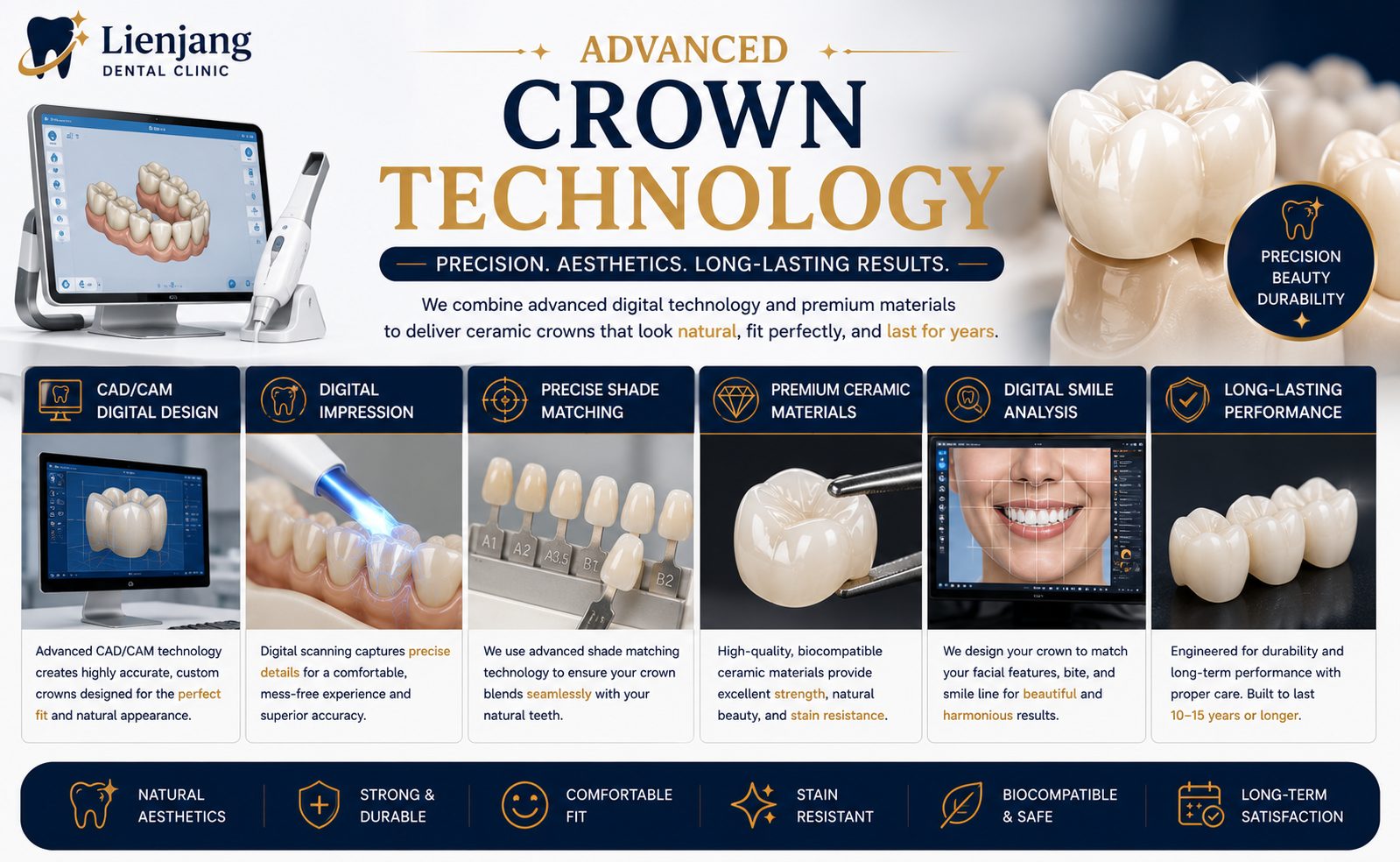
Lienjang Dental Clinic currently promotes an in-house digital laboratory and digital dental scanning for selected prosthetic treatments.
A digital scanner can record the prepared tooth, neighbouring teeth and bite without relying entirely on a conventional impression.
These records may support the planning of the crown’s shape, contact points, biting surface and relationship with surrounding teeth.
An in-house laboratory can also support direct communication between the dentist and dental technician during design, shade selection and adjustment.
Digital technology does not guarantee a perfect fit, identical shade match or one-day completion. The result still depends on the diagnosis, tooth preparation, selected material, laboratory process and final bite adjustment.
The dentist examines the tooth, gums, bite and existing dental work.
Dental X-rays or other imaging may be recommended to assess decay, cracks, previous root-canal treatment and the condition of the surrounding structures.
The dentist should explain why a crown is being proposed and whether a filling, onlay, veneer or another treatment could be appropriate.
Local anaesthetic may be used before preparation.
The dentist removes decay, weakened material and enough tooth structure to create space for the planned crown.
The amount removed depends on the material, tooth condition and restoration design. Preparing a natural tooth for a full crown is irreversible.
Where little healthy structure remains, a core build-up or post may be required.
The prepared tooth, nearby teeth and bite are recorded using a digital scanner, conventional impression or a combination of techniques.
The records are used to design the crown’s shape, margin, contact points and biting surface.
A temporary crown may be placed when the permanent restoration is not ready during the preparation appointment.
Temporary crowns protect the tooth for a limited period but are usually less durable than the final restoration.
The clinic should explain which foods and habits to avoid and what to do if the temporary crown becomes loose or falls off.
The final crown is produced according to the selected material and laboratory design.
Lienjang advertises selected prosthetic workflows that may be completed within approximately 24 hours through its digital laboratory. The clinic also states that completion time varies according to the patient’s oral condition.
More complex colour matching, gum treatment, root-canal treatment or multiple crowns can require additional time.
Before final placement, the dentist checks the crown’s fit, margins, shape, shade, contact with neighbouring teeth and bite.
Adjustments may be required before the crown is permanently cemented or bonded.
After placement, the bite should be checked again. A crown that feels significantly high or uncomfortable may require further adjustment.
Selected cases may qualify for Lienjang Dental Clinic’s faster digital laboratory workflow.
A crown may require more than one visit when the tooth also needs root-canal treatment, a post or core, gum care, complex shade matching or additional healing.
A temporary crown may also be required.
International patients should request a visit-by-visit schedule rather than relying only on the phrase “one day.”
The clinic should confirm when the tooth will be prepared, whether a temporary crown will be used and when the permanent restoration will be fitted.
Many patients can return to routine daily activities after crown placement.
Temporary sensitivity, gum tenderness, pressure or awareness of the new bite can occur. Wait until local anaesthetic numbness has worn off before eating.
During the first few days, avoid testing the crown with ice, very hard foods or other objects.
Brush normally, clean carefully between the teeth and pay particular attention to the crown margin. A crown does not make the underlying tooth immune to decay or gum disease.
Patients can review dental scaling and professional teeth cleaning at Lienjang Dental Clinic as part of ongoing oral-health maintenance.
Contact the clinic if the crown feels high, becomes loose, chips or causes persistent discomfort.
There is no guaranteed lifespan for a ceramic crown.
Some crowns remain functional for many years, while others require earlier repair or replacement.
Longevity depends on the ceramic material, tooth position, amount of remaining natural structure, crown fit, bite forces, teeth grinding, oral hygiene, gum health and regular dental care.
A crown should not be marketed as permanent or maintenance-free.
Ask the clinic whether it provides a written warranty, what the warranty covers and which conditions could invalidate it.
Ceramic crown treatment is widely used, but complications can occur.
Possible issues include temporary or persistent sensitivity, gum irritation, bite discomfort, colour mismatch, crown loosening, cement failure, chipping, fracture, gum recession or decay around the crown margin.
A prepared tooth may later develop inflammation and require root-canal treatment. A crown can also require adjustment, repair or replacement as the tooth, gums and bite change.
Contact the dentist promptly if you develop severe pain, facial swelling, fever, discharge, persistent sensitivity, pain when biting or movement of the crown.
A loose crown should be assessed by a dentist rather than permanently reattached at home.
A ceramic crown may restore the shape, appearance and function of a selected tooth while protecting the remaining structure.
The final result depends on the diagnosis, tooth condition, preparation, crown material, laboratory process, fit, shade, bite and gum health.
A natural-looking appearance is a treatment goal, not a guaranteed outcome. A crown may not match surrounding teeth perfectly under every form of lighting.
Ceramic crowns can chip, loosen, wear or require replacement. Routine dental care remains necessary after treatment.
The consultation enquiry submitted through Fornur is free. Ceramic crown treatment is not free.
The current page does not provide a reliable confirmed crown price.
The complete cost can depend on the tooth being treated, ceramic material, dental imaging, tooth preparation, temporary crown, laboratory work and any additional treatment required beforehand.
Before paying, request an itemised quotation covering:
Cost component | What should be confirmed |
Dental examination | Included or charged separately |
X-rays or 3D imaging | Type, necessity and price |
Digital scan | Included or additional |
Crown material | Exact ceramic system |
Crown price | Price per tooth |
Core build-up or post | Included or separately charged |
Root-canal treatment | Included or separate |
Temporary crown | Included or additional |
Laboratory work | Included or separate |
Final fitting | Included adjustments and follow-up |
Warranty | Duration and conditions |
Tax | Included or additional |
The final crown, examination, imaging, temporary restoration and laboratory work should not be presented as included in the free enquiry unless the clinic confirms this in writing.
Clinic: Lienjang Dental Clinic
Location: Gangnam, Seoul
Address: 13F, 343 Gangnam Tower, 403 Gangnam-daero, Seocho-gu, Seoul
Consultation: Free consultation enquiry through Fornur
International Patients: Foreigners welcome
Language Positioning: English-speaking dental care is currently promoted
Monday and Friday: 10:00 AM to 9:00 PM
Tuesday to Thursday: 10:00 AM to 7:00 PM
Saturday: 10:00 AM to 4:00 PM
Lunch break: 1:00 PM to 2:00 PM
Sunday and public holidays: Closed
Opening hours, dentist availability and laboratory scheduling should be reconfirmed for the requested appointment.
Before requesting ceramic crowns at Lienjang Dental Clinic, share which tooth or teeth are involved, current symptoms and details of previous fillings, crowns or root-canal treatment.
Recent dental X-rays may help communicate the concern, but the clinic may still require new imaging.
Mention teeth grinding, allergies, medical conditions, medicines and any previous crown complications.
International visitors should confirm the number of visits, exact crown material, temporary-crown arrangements, laboratory timeline and final fitting date before booking travel.
Leave enough time after final placement for the dentist to check the bite and complete any necessary adjustment before departure.
Fornur facilitates the consultation enquiry. It does not diagnose dental conditions, select crown materials or perform treatment.
Visitors can also explore other Beauty & Medical services in Korea.
Share the tooth or teeth involved, current symptoms, previous dental treatment, recent X-rays where available, teeth-grinding history, preferred appointment dates and available time in Korea.
Fornur can help you request a free consultation and itemised treatment plan for ceramic crowns at Lienjang Dental Clinic.
The dental team will confirm whether a crown is appropriate, which ceramic material is proposed, how much tooth preparation is required, the number of visits, laboratory timeline, aftercare and complete price.
Your cart is empty
Continue Shopping